
YouFine Foundry -- Established 1983
How to Make a
Bronze Horse Statue
Inside a foundry that has made more than 5,000 of them -- from clay armature to patina, told from the inside.
40 Years · 5,000 Sculptures · Quyang, Hebei -- China's Historic Sculpture Capital
The Honest Version
We Have Made More Than 5,000 Bronze Horses.
Here Is What We Know.
Most articles about making a bronze horse statue describe the same process in the same order: clay model, silicone mold, lost wax casting, patina, done. The steps are accurate. The understanding behind them is often thin.
We are YouFine Sculpture. We have been casting bronze in Quyang, Hebei -- China's historic sculpture capital -- since 1983. In that time, we have made more than 5,000 bronze horse sculptures, refined 500+ original design templates, and worked through every failure mode the process has to offer.
This is the version of the guide that comes from actually doing the work.
Forty Years of Refinement
The Process: Nine Stages
Clay Sculpting
Where Everything Is Won or Lost
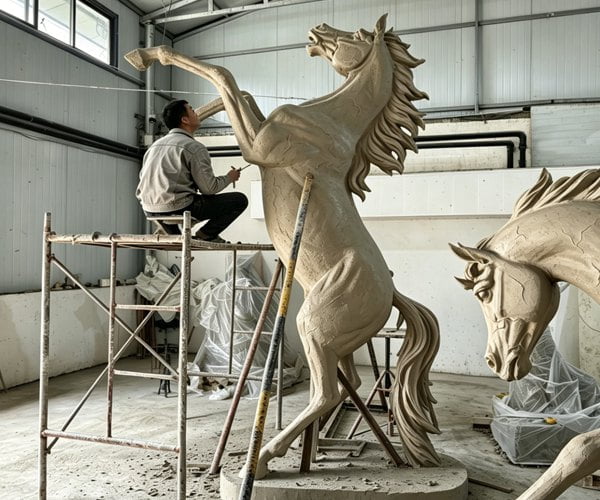
The clay model is the soul of the sculpture. Every downstream stage is reproduction. There is no correcting anatomy in bronze.
Two of our senior artists have kept horses on their own property for more than 15 years. This shows: the way a gluteus medius changes shape between the power phase and the swing phase of a gallop; the exact tension of a nostril at full exertion; the compression of the fetlock when weight shifts onto a foreleg.
These details are invisible to most buyers during clay approval. They are permanently felt by anyone who stands next to the finished piece.
A well-executed life-size clay model takes 15 to 30 days. Any foundry quoting 7 days is rushing or using a 3D-milled foam core -- and the surface character will show it.
Silicone Mold Making
The Decision No One Talks About
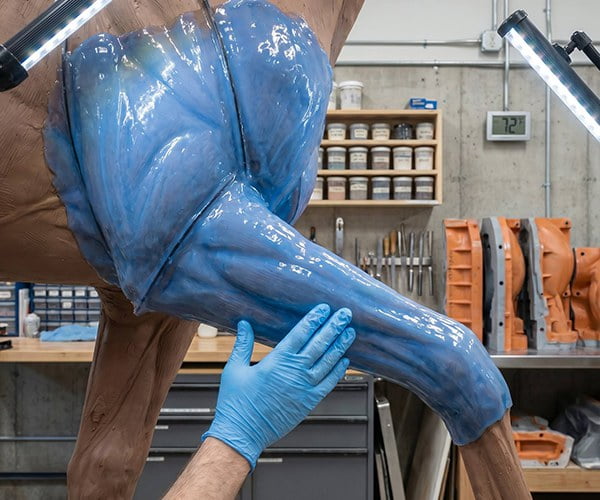
A life-size horse is not molded as one unit. It is divided into 30 to 80 individual sections, each molded separately. Where those seam lines fall determines whether weld lines are invisible in the finished bronze -- or permanently visible despite all subsequent chasing.
A seam placed along a muscle ridge or a mane strand disappears into the existing texture. A seam across a smooth flank requires intensive metalwork to conceal, and sometimes remains faintly detectable. At our production scale, seam planning is handled by a dedicated team member whose sole job is to evaluate this problem before a drop of silicone is applied.
Wax Chasing
The Refinement Step Most Foundries Rush
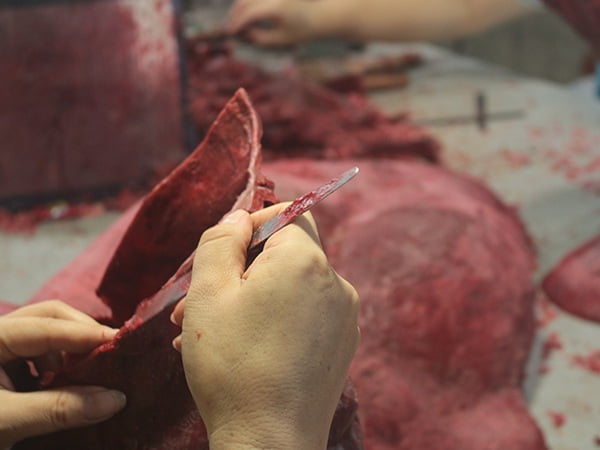
Once the wax sections are pulled from the silicone molds, they are not yet ready for ceramic coating. Each carries the marks of molding: faint seam lines, small surface bubbles, areas where the wax pulled away from fine detail. Before a single dip of ceramic slurry, every imperfection must be corrected by hand.
Working under strong directional lighting -- often with magnification -- our chasing artists use heated metal tools and fine instruments to repair the surface section by section. Seams are melted smooth, bubbles filled and re-textured, and lost detail -- a strand of mane, the edge of a nostril, the texture of a hoof -- is re-carved to match the original clay.
A chased wax section should be, in every meaningful sense, identical to the original clay surface. It is the last moment the sculpture can be refined by hand before metal takes over. There is no correcting surface detail after the pour.
Silica Sol Shell Building
The Material Decision That Determines Outdoor Longevity
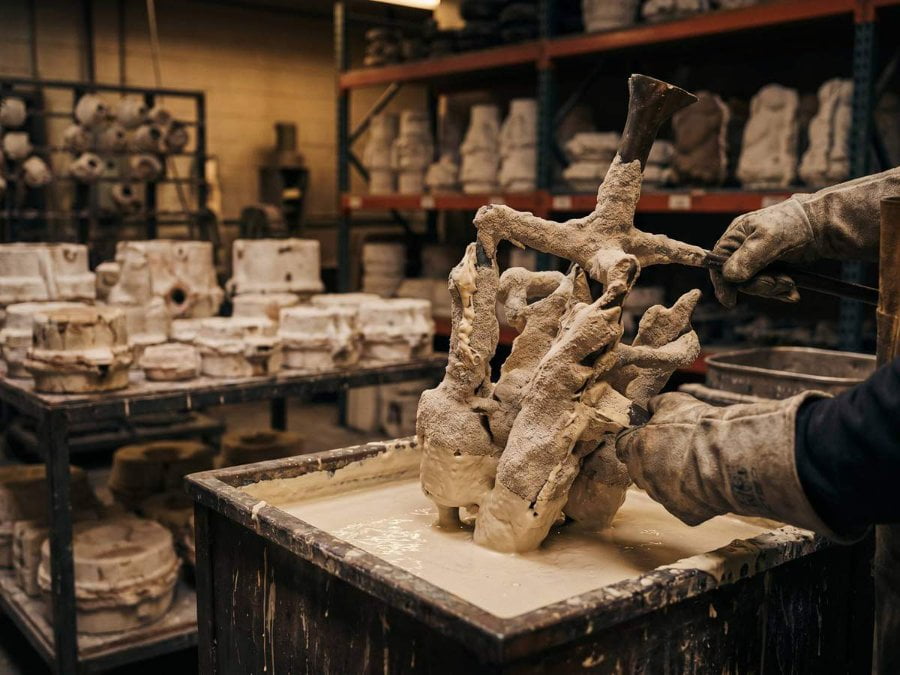
With the wax chased and a bronze gating system attached, each assembly is ready for ceramic shell construction. We use silica sol (colloidal silica) as our binder for all outdoor bronze. Each assembly is dipped into slurry, rolled in fine silica sand, and dried completely before the next cycle -- repeated 8 to 12 times to build an 8-15mm shell over 10 to 15 days.
The drying time between layers is non-negotiable. A layer applied too early produces micro-delaminations -- invisible until the pour, when thermal shock cracks them open. This is a common cause of pour failure in foundries compressing timelines.
Traditional clay-sand shells are more porous, allowing moisture to penetrate the bronze surface and produce white spotting or premature green corrosion within three to five years. Silica sol shells produce a denser, less porous surface that resists this far longer.
We transitioned to silica sol for all outdoor sculpture in 2001 -- after eighteen years watching the field performance of both methods.
Lost Wax Casting
The Pour
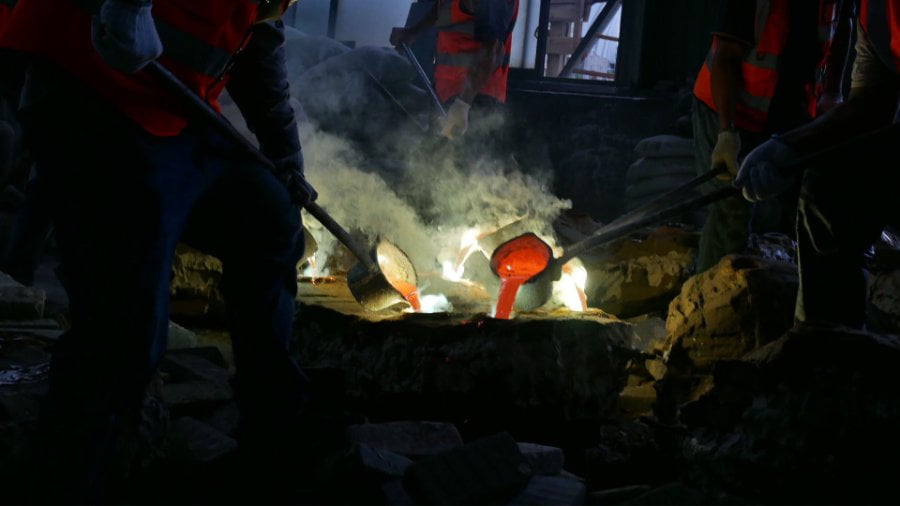
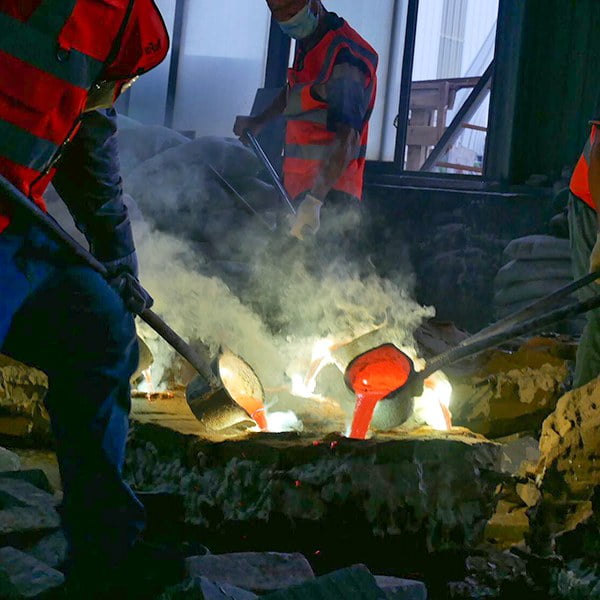
The lost wax technique dates to 3700 BCE. The principle has not changed: build a wax positive, encase it in ceramic, burn out the wax, pour in molten bronze. By this stage, weeks of preparation converge into a few minutes of irreversible action.
Shells are loaded into a burnout oven at 900°C. The wax drains and burns off, leaving a hollow cavity that is an exact negative of the wax. Molten C90500 bronze -- 88% copper, 10% tin, 2% zinc -- is prepared at ~1,100°C and poured in a controlled sequence, 4 to 8 minutes per section.
After cooling, the ceramic is broken away and raw bronze emerges. Each section is inspected for casting defects. Sections that fail are re-cast, not repaired.
- Burnout oven at 900°C removes the wax
- Shells pre-heated to reduce thermal shock
- Molten C90500 bronze (88% Cu, 10% Sn, 2% Zn) at ~1,100°C
- Pour of ~4-8 minutes per section
Casting rejection rate: below 4%
Welding & Metal Chasing
The Hidden Craft
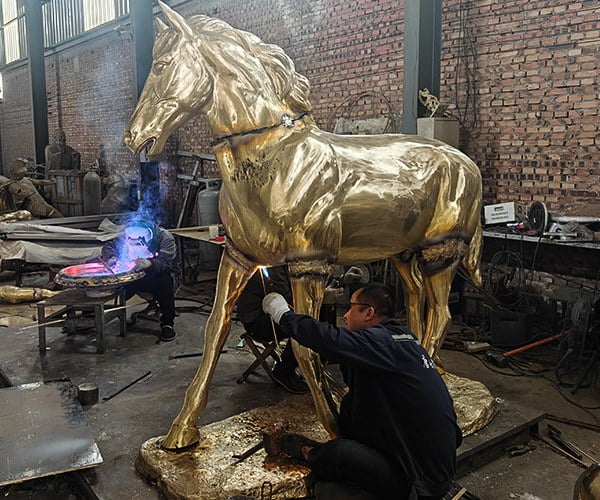
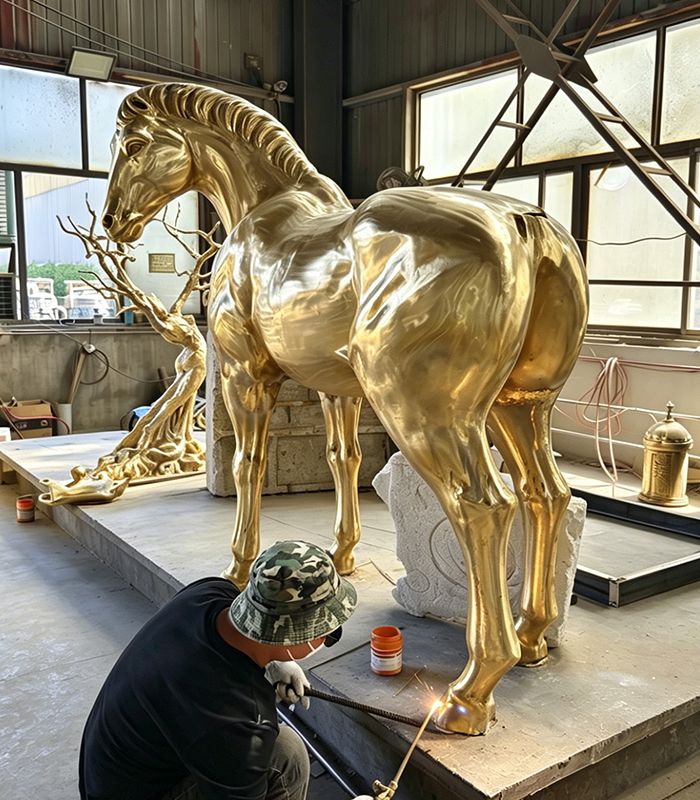
Thirty to eighty bronze sections must become one seamless sculpture. We use TIG welding with a filler rod of the same C90500 alloy -- after patina, matched filler is chemically indistinguishable from the surrounding metal. Mismatched filler shows as a permanent seam line.
Chasing artists work every joint with grinders, rotary files, and hand tools, removing weld beads and rebuilding muscle definition at each seam -- 5 to 15 days on a life-size horse, longer for a rearing horse with detailed mane across multiple welds.
Our standard: no weld seam detectable at 50cm. Latest internal audit: fewer than 2% of seams failed.
Patina
The Step That Takes the Longest to Learn
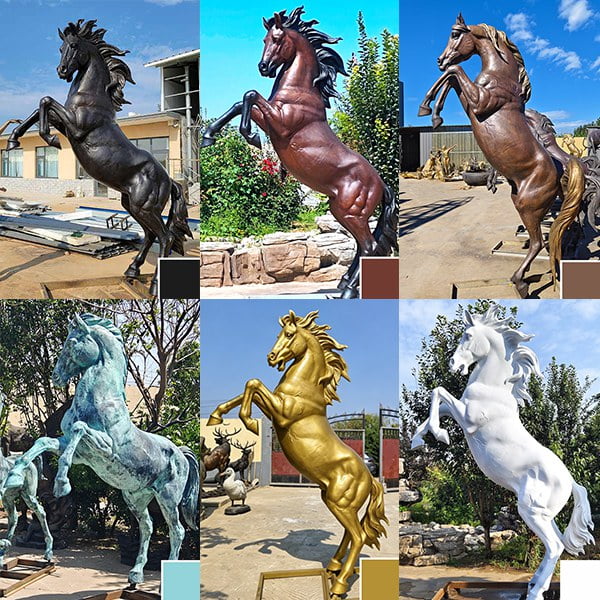
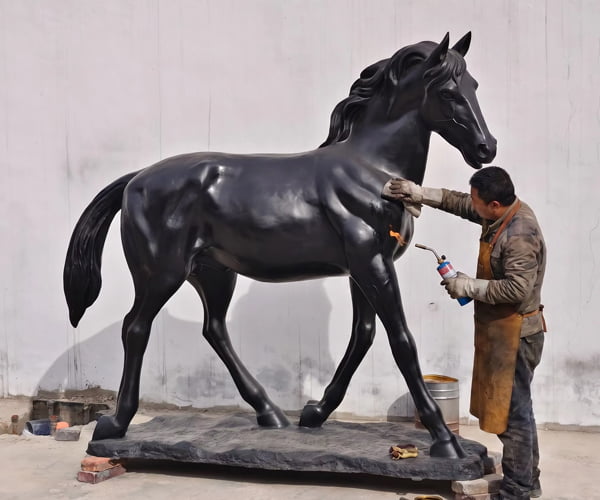
Patina is not a coating. It is a controlled chemical reaction between bronze and metal compounds, directed by heat. Applied at the right temperature, the color becomes part of the metal. Applied too cold, it peels within two to three years.
The skill is temperature intuition -- reading the color shift of heated bronze and applying the chemical in the five-to-fifteen-second window when the surface is ready. This takes years to develop reliably.
We have documented 200+ distinct patina color profiles since 1983. Send a reference photo and we can identify, with high confidence, the chemical sequence that produced it.
Wax Sealing
Where Longevity Is Decided
After patina, the sculpture is heated to 60-80°C and carnauba or microcrystalline wax is applied by hand, melting into the micropores of the bronze surface. This is not spray wax. Thermal hand application bonds the wax to the metal; spray application merely coats the surface. The difference shows after years outdoors.
| Climate | Wax Interval | Primary Risk |
|---|---|---|
| Temperate (C. Europe, U.S. Midwest) | Every 2 years | General weathering |
| Maritime / Coastal | Every 12 months | Salt air oxidation |
| Tropical / High Humidity | Every 12 months | Moisture and UV combined |
| Desert / High UV | Every 18 months | UV color fade |
Inspection, Packing & Delivery
The Last Thing We Control
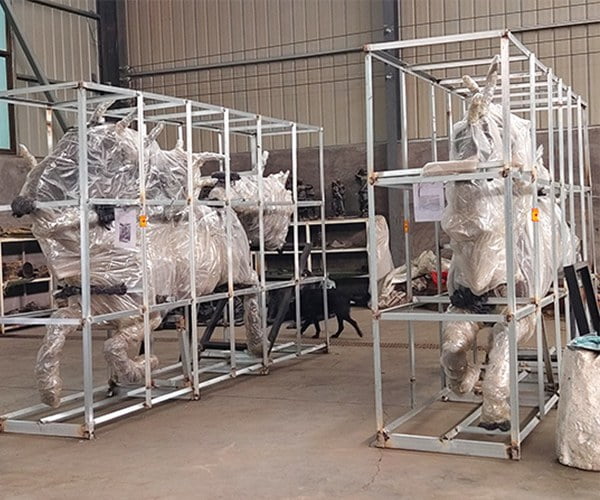
A bronze horse can survive decades outdoors and still arrive damaged if the packing is wrong. Before packing, every sculpture undergoes a final inspection: patina reviewed under natural light from multiple angles, every weld seam checked against the 50cm standard, drainage confirmed open and correctly positioned. Anything that does not meet standard goes back.
Packing is built around the geometry of each piece. Every export crate is custom-built in solid timber with interior foam and timber cradles engineered to prevent movement under forklifts, container stacking, and ocean swell. The sculpture is photographed in its final condition and again fully packed before the lid is fixed.
We have shipped to more than 60 countries. We coordinate directly with the client's freight forwarder or customs broker and remain available through arrival and installation.
- Full export documentation and HS tariff codes
- Packing photography for customs and insurance
- Installation guide: base plate, foundation, hardware
- Climate-specific maintenance schedule
What Separates Quality
The Three Specifications That Separate a Century-Lasting Bronze from a Decade-Lasting One
1. Alloy Composition
We use C90500 gunmetal bronze: 88% copper, 10% tin, 2% zinc. The high tin content creates a dense, self-protective oxide layer. Some foundries use leaded C83600 -- cheaper, easier to machine, inferior outdoor corrosion resistance. Always ask for the alloy designation and a material test certificate.
2. Wall Thickness
Structural sections should be 6-8mm minimum. Thinner than 4mm reduces rigidity, shortens the surface available for patina development, and increases impact vulnerability. Some foundries cast at 3-4mm to save material -- visible only in the shipping weight, and in the sculpture's condition after ten years outdoors.
3. Internal Drainage
Outdoor hollow bronze accumulates water internally through condensation. Standing water against internal welds accelerates corrosion from the inside out -- invisible until it has progressed. We drill drainage holes at the lowest structural points of every outdoor sculpture. Many foundries do not. It never shows in a portfolio photo.
The Engineering Problem
Why a Horse Is the Hardest Subject in Bronze
A horse has 205 bones and approximately 700 muscle groups. Its center of gravity shifts dramatically with every change in pose. When you capture that in bronze -- a material weighing 8.5 grams per cubic centimeter that never moves -- you inherit every structural problem that living biomechanics solved through constant motion.
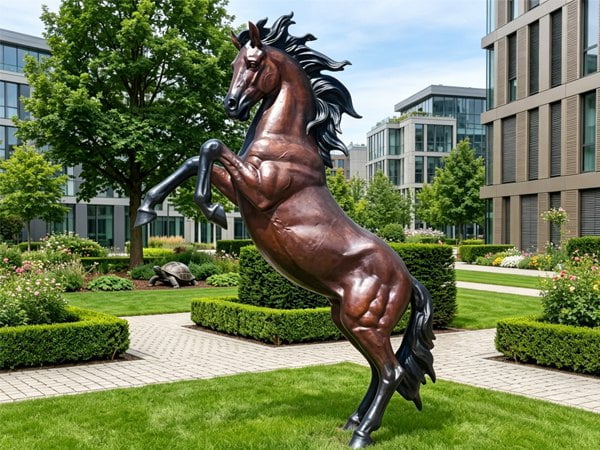
A rearing horse in real life balances through thousands of micro-adjustments per second. In bronze, those same hindquarters must carry 300 to 800 kilograms of dead weight permanently, through two legs often no wider than a human thigh.
This is why pose selection is not just an aesthetic decision. It is an engineering one.
Pose Determines Everything
The Pose You Choose Determines Everything That Follows
After 5,000 horses, we classify poses by engineering difficulty -- which drives the internal armature, timeline, structural complexity, and long-term integrity.
| Pose | Difficulty | Core Engineering Risk | Production Time |
|---|---|---|---|
| Standing (four legs grounded) | ★☆☆☆ | Proportional accuracy | 25-30days |
| Walking / Grazing | ★★☆☆ | Offset weight distribution | 30-35 days |
| Galloping / Jumping | ★★★☆ | Cantilever stress on extended legs | 35-40 days |
| Rearing (hind legs only) | ★★★★ | Full load on two-point base -- structural engineering required | 40-50 days |
The 2006 Rearing Horse
A rearing horse is structurally different from a standing one. For any rearing or galloping commission, we commission a structural load calculation before clay work begins. The internal steel framework is designed like a small bridge -- calculated, not improvised.
In 2006 we completed a 3.2-meter rearing piece for a German commercial park, using 14mm steel bar where 10mm was standard. Twenty years later the client called: two decades of European winters, not a single weld crack. That commission established the rearing horse protocol we still use today.
Due Diligence
Questions Worth Asking Any Foundry
Designed so a foundry doing things correctly can answer them immediately. Here is how we answer each one.
01 What bronze alloy do you use for horse sculptures, and can you provide a material test certificate?
02 Who will sculpt the clay model, and how much equine sculpture experience do they have?
03 Will I see photos of the completed clay model before mold-making begins?
04 Do you use silica sol casting or the cheaper clay-sand method?
05 Is your patina applied with torch heat or simply sprayed on?
06 Do you engineer internal drainage and structural support for outdoor horse statues?
07 Can you provide references and shipping experience for clients in my country?
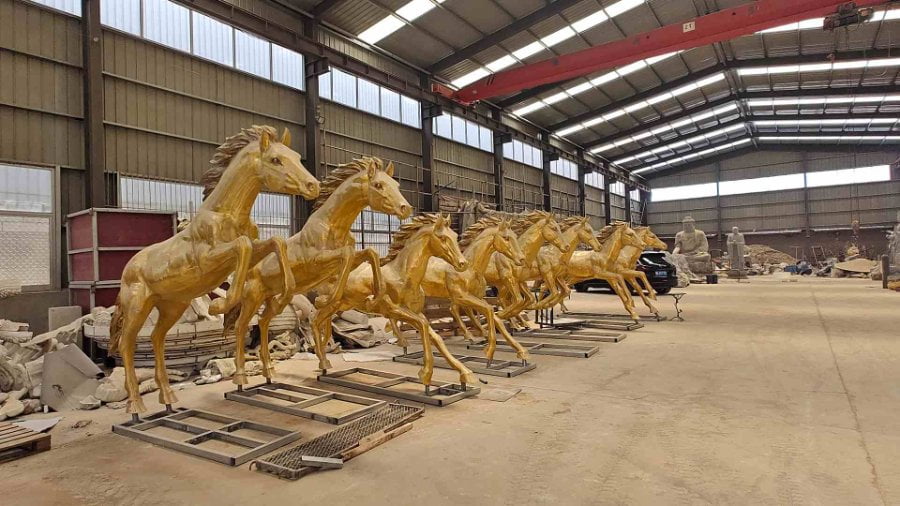
Institutional Knowledge
What 5,000 Horses Actually Means
We are not the largest bronze foundry. We are the one that has made more than 5,000 horse sculptures -- and kept records on every one.
Production-ready design templates, each refined through real installations and client feedback.
Documented production stages from design confirmation to shipping.
Casting rejection rate -- sub-standard sections are re-cast, not repaired.
Weld seam detection rate at the 50cm quality standard.
Documented patina color profiles, available for reference matching.
Climate-specific maintenance guidance for every sculpture, every destination.
This is not a portfolio of the best work from 40 years. It is the institutional knowledge of what good bronze sculpture actually requires -- accumulated across 40 years and more than 5,000 commissions.
Start Your Custom Project
Whether you need a statement piece for your estate or a custom design for your equestrian property, our team is ready to bring your vision to life with premium bronze craftsmanship.