
What 40 Years of Bronze Casting Taught Us About Symbolism, Scale, and Space
By YouFine Sculpture | Est. 1983 | Life-Size Bronze Horse Specialists
Horse statues meaning is one of the most searched topics in art and landscape design, and almost every result gives you the same answer: the number of raised hooves tells you how a soldier died.
We’re going to tell you why that answer misses the point entirely.
At YouFine, we have been casting bronze horse sculptures since 1983. Not decorative mantle pieces. Not resin reproductions. Life-size — and larger — bronze horses that weigh over a ton, ship to six continents, and stand at the entrances of luxury estates, government plazas, and equestrian centers worldwide.
After four decades and thousands of commissions, here is what we have actually learned about what horse statues mean — not in textbooks, but in the real world of the people who commission them, stand before them, and live beside them.
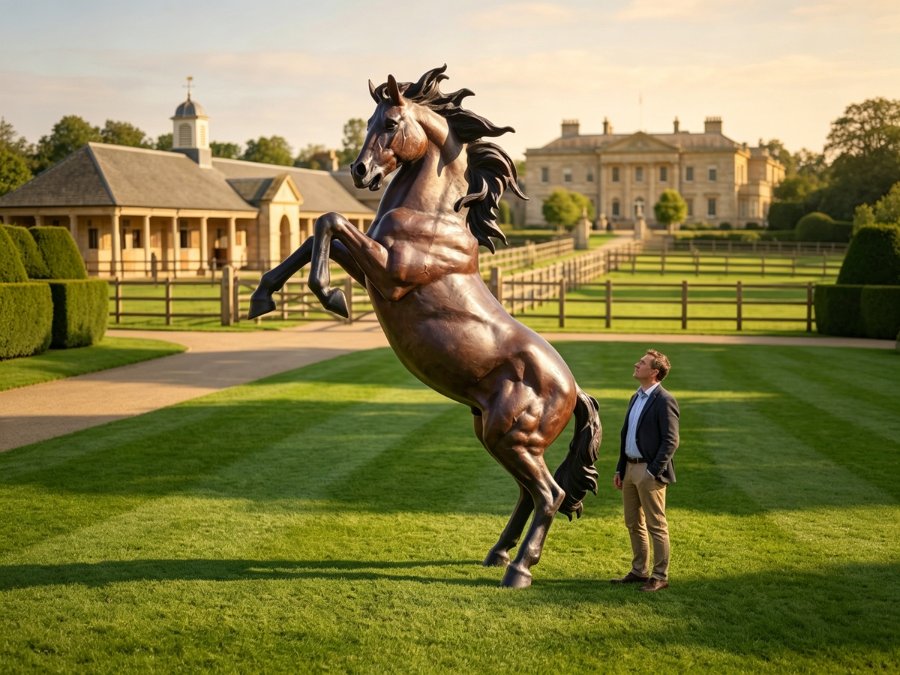
The Gettysburg “Code” Is a Myth — Here’s What Actually Matters
Let’s address it directly. The most viral piece of horse statue lore is the Civil War battlefield legend: if a horse has both front legs raised, the rider died in combat; one leg raised means wounded; all four legs down means died of natural causes.
Researchers have tested this against actual monuments at Gettysburg. It doesn’t hold up. It’s a folk story, not a sculptor’s rule12.
But here’s the more important question: Why does that myth persist?
Because humans instinctively understand that a horse’s posture carries meaning. We feel it before we can explain it. A rearing horse creates tension in your chest. A galloping horse makes you lean forward slightly. A standing horse gives you a sense of grounded calm.
The “hoof code” is a shortcut for something real: the body language of a horse statue shapes the emotional atmosphere of a space. That’s the actual symbolism, and it runs far deeper than battlefield lore.
What Horse Statues Actually Mean: A Founder’s Perspective
When a client commissions a life-size bronze horse from YouFine, they rarely call it “symbolism.” They say things like:
- “I want people to feel something when they enter my property.”
- “I need a centerpiece that represents what this company stands for.”
- “I want my grandchildren to remember this place.”
Every single one of those requests is about meaning. Here is what we’ve learned those meanings actually are:
1. Scale Is a Statement About Seriousness
A horse figurine on a desk is a hobby. A life-size bronze horse at your entrance is a declaration.
When a sculpture matches the true biological scale of a living animal — a thoroughbred stands 16 to 17 hands3, roughly 5.5 feet at the shoulder — it creates what designers call spatial presence. The sculpture doesn’t decorate the space; it claims it.
This is why governments, five-star hotel groups, and landmark estate owners consistently choose life-size or larger. A smaller-than-life horse whispers. A true-scale horse speaks. An over-scale horse — the kind we cast at 1.5x or 2x life size — commands silence.
Scale isn’t vanity. It’s clarity of intention.
2. Bronze Is the Only Material That Ages Into Meaning
We work with marble, stainless steel, and resin on request. But for horse statues, bronze has always been the definitive choice — not for tradition’s sake, but for a specific physical reason.
Bronze moves with time. A freshly cast horse has a warm, golden-brown surface. Over years, it darkens, develops green-blue patina in recessed areas4, lightens at contact points where hands and weather touch. After a decade outdoors, a well-cast bronze horse looks like it has actually lived.
Marble is beautiful but cold — static in the way that marble always is. Stainless steel reflects the present moment. Bronze accumulates the past.
For a sculpture that carries symbolism across generations — strength, legacy, continuity — no other material makes the same argument that bronze does.
Our lost-wax casting process5 (the same method used since ancient Greece) allows us to capture details at sub-millimeter precision: the tension line of a flexed tendon, the way a mane separates in motion, the flared geometry of a nostril mid-breath. When you stand before a well-cast bronze horse, the detail itself communicates authenticity. And authenticity is the foundation of meaning.
3. The Pose Defines the Energy of the Space — Choose Deliberately
This is where most buyers focus, and rightly so. But the decision should be driven by the energy you want the space to hold, not by an arbitrary legend.
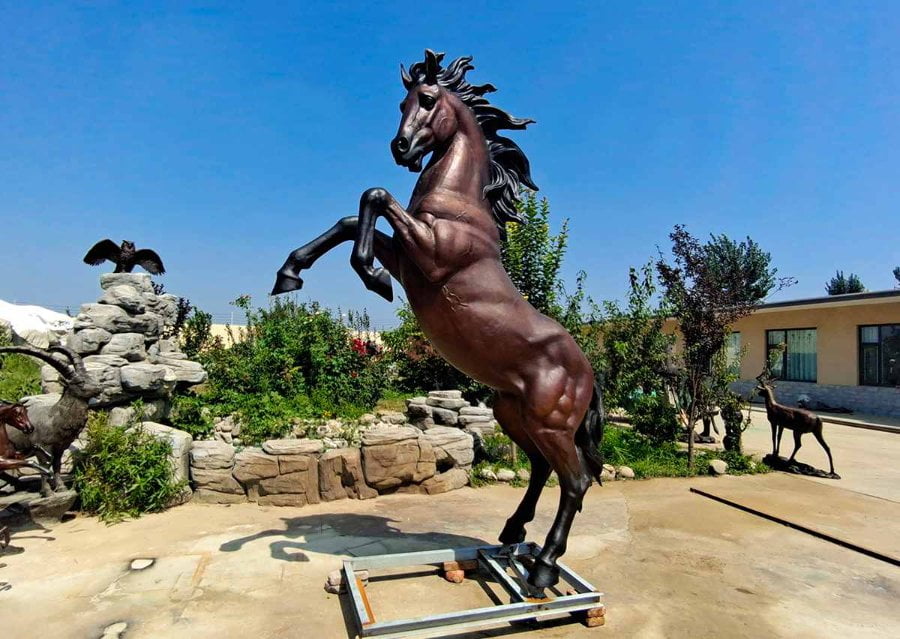
The Rearing Horse
Both front legs off the ground. This is the most visually dramatic pose — and deliberately so. It captures the precise moment of maximum energy: not aggression, but transformation. The horse is not attacking; it is ascending.
We recommend this pose for:
- Business or institutional entrances where you want to signal ambition, disruption, or breakthrough
- Spaces that mark the beginning of something — the entrance to a new development, a commemorative installation, a landmark at a trail’s head
- Owners who want to communicate that they are still climbing, not yet arrived
The psychological effect on a visitor is immediate: forward lean, elevated pulse, a sense that something significant is happening here.
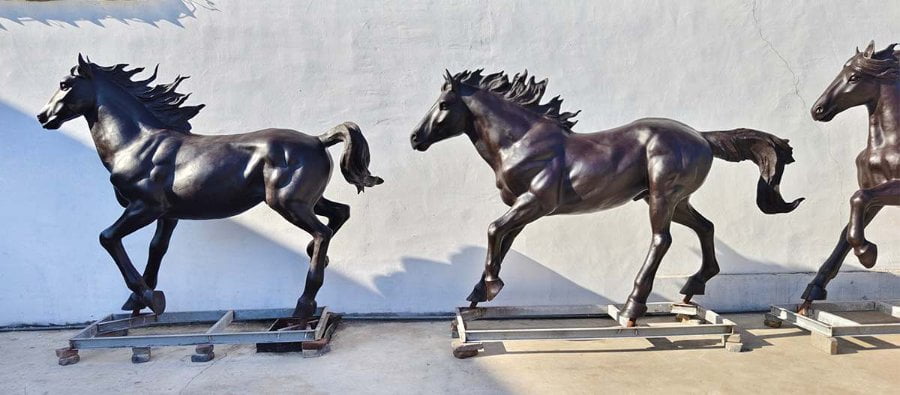
The Galloping Horse
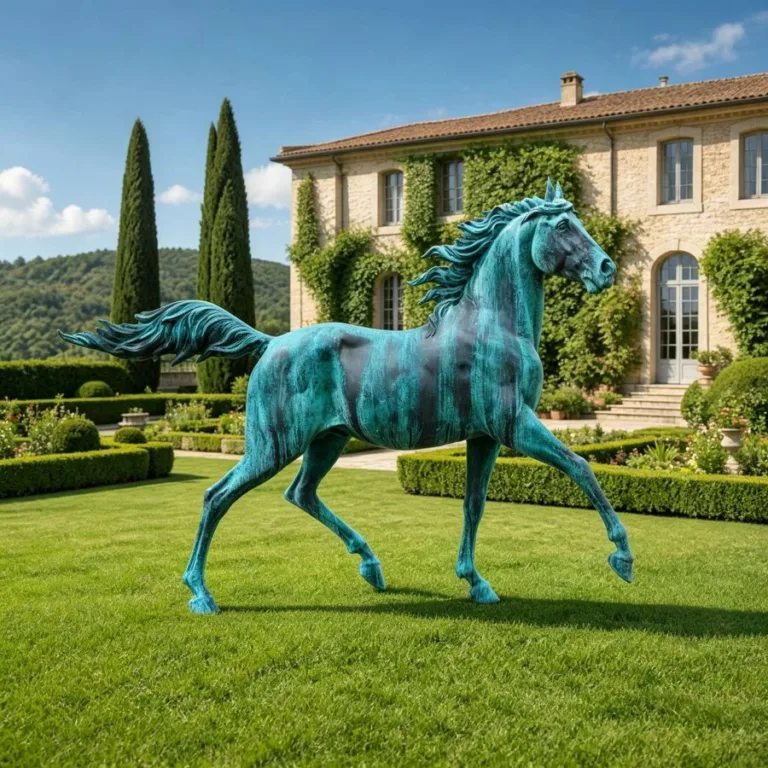
Four hooves off the ground, full extension, mane and tail in motion. This is perhaps the most technically demanding pose for a foundry, because the entire sculpture must be structurally supported through the moment of pure flight.
At YouFine, a galloping horse commission requires internal steel armature engineering before a single layer of wax is applied. The result, when done correctly, appears to defy gravity — which is precisely the meaning it communicates.
This pose suits:
- Properties where momentum and progress are core values
- Large open landscapes where the sculpture needs to hold its own against spatial scale
- Owners who have achieved velocity and want to mark it
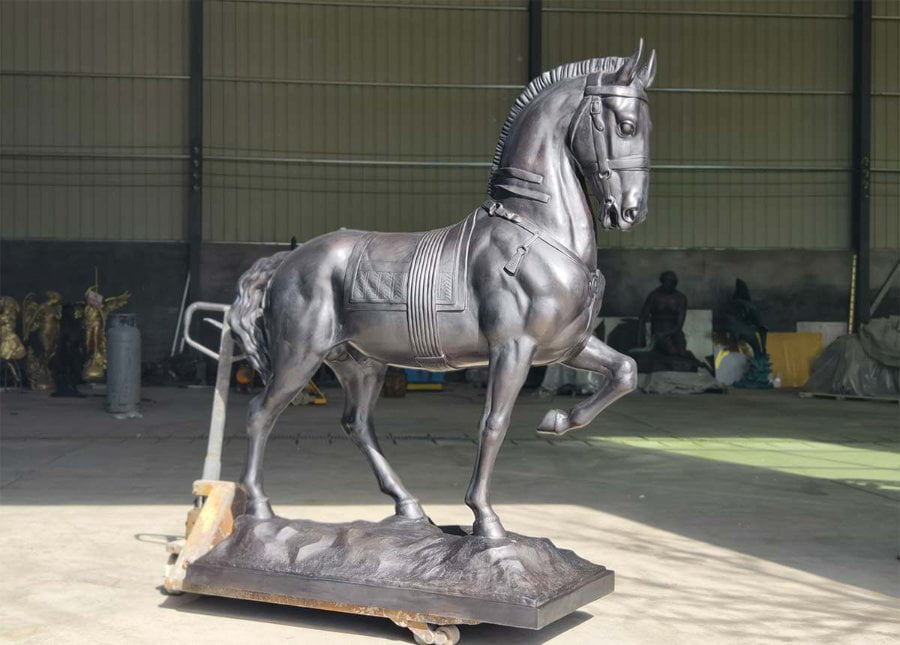
The Standing Horse
Four hooves grounded, head held, alert but still. This is not a “lesser” pose — it is the pose of sovereignty. A standing horse is aware of everything and moved by nothing.
We have placed standing horses at the entrances of private estates where the owner’s message is: This is a place of permanence. We are not chasing anything. Everything worth having is already here.
It suits formal gardens, institutional facades, memorials, and spaces where dignity and continuity matter more than energy.
The Grazing Horse
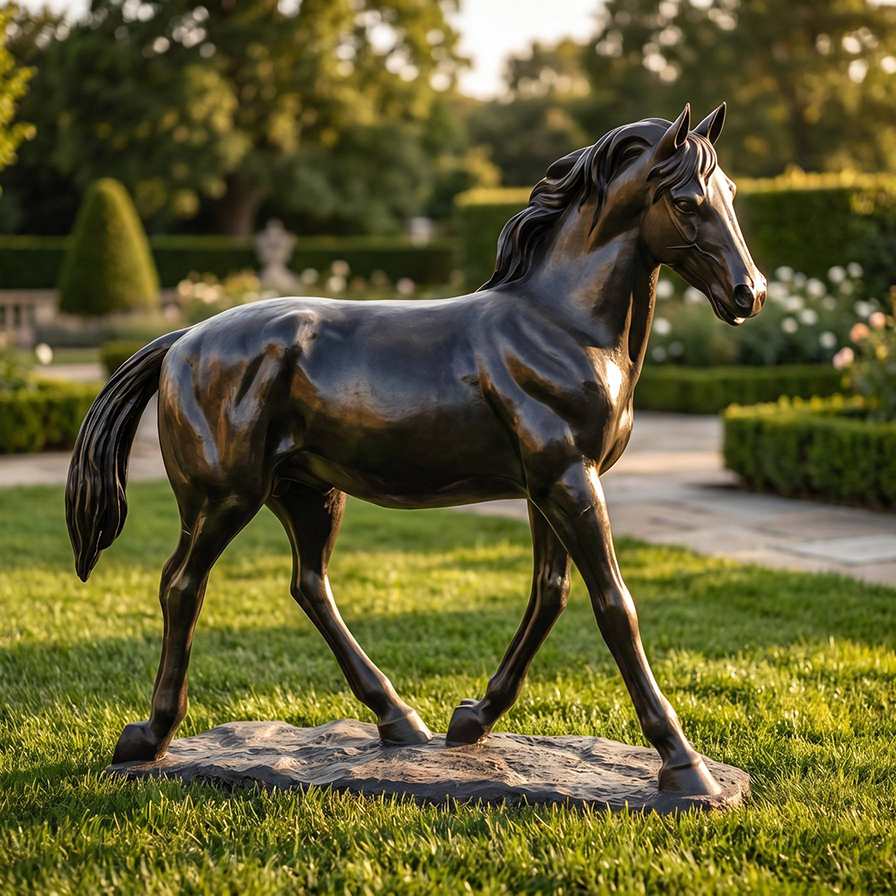
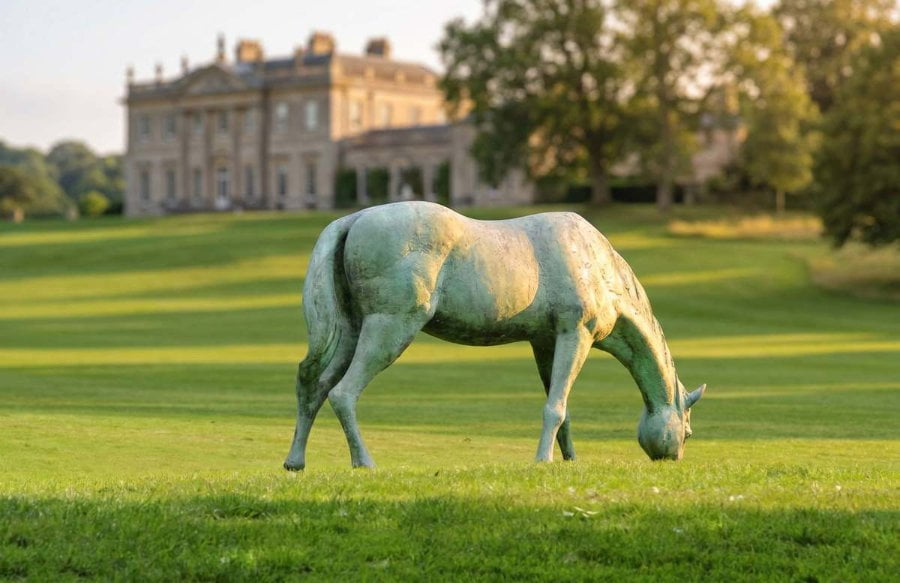
Head lowered, weight settled. This is the pose of genuine peace — and it is far rarer in commissioned sculpture than its emotional value deserves.
A grazing horse communicates something almost radical in contemporary design: that a space is safe enough for stillness. We have placed these at private retreats, wellness estates, and rural properties where the owner wants to create a sense of sanctuary rather than arrival.
Cultural Meanings of Horse Statues: The Nuance Most Guides Ignore
In Western Tradition: Authority Earned Through Partnership
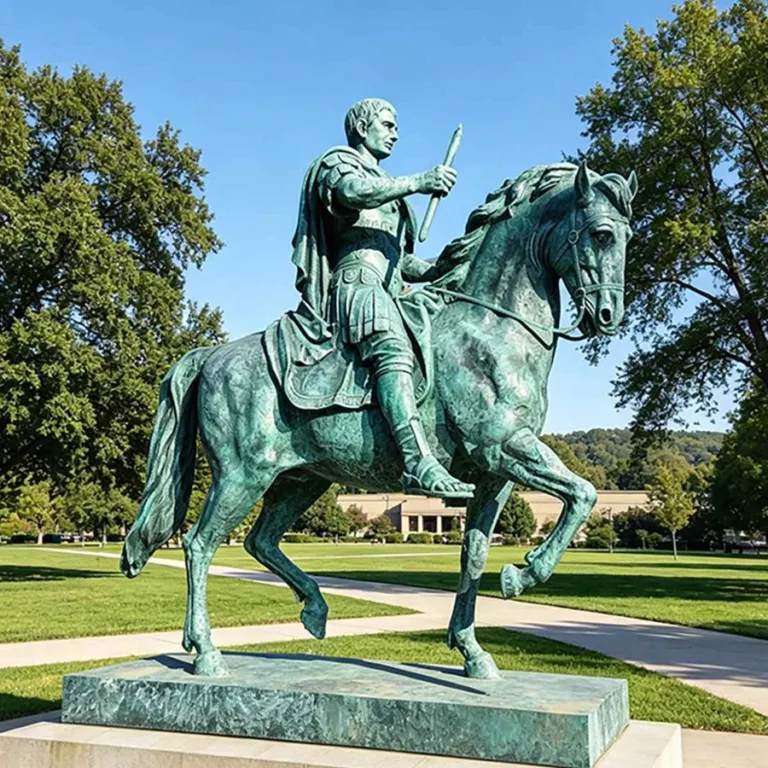
The great equestrian statues of Western history — Marcus Aurelius in Rome6, the Gattamelata in Padua — all share a fundamental message: the rider and the horse are in agreement. The horse is not subdued. It is partnered.
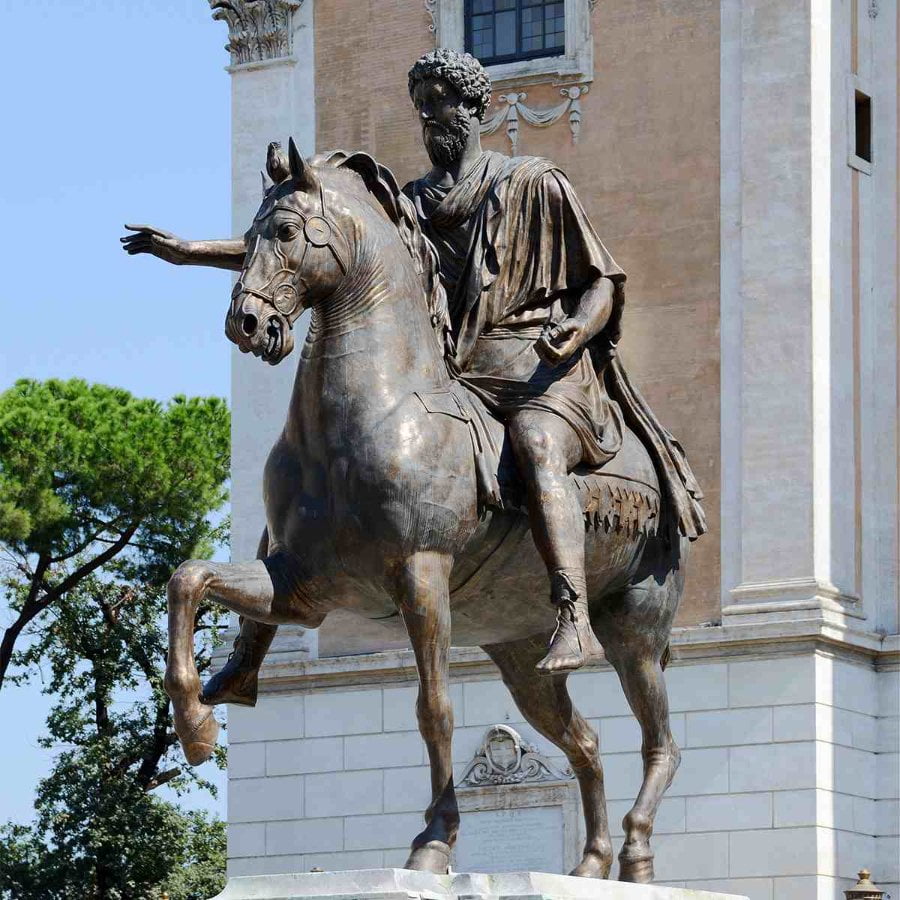
This is a subtle but important distinction. The Western symbolic tradition does not celebrate dominance over horses; it celebrates the relationship between human will and animal power. When a modern collector places a bronze equestrian statue, they are invoking that partnership — the idea that great things are accomplished not through force, but through trust and alignment.
In Chinese Tradition: The Horse as Cosmic Engine
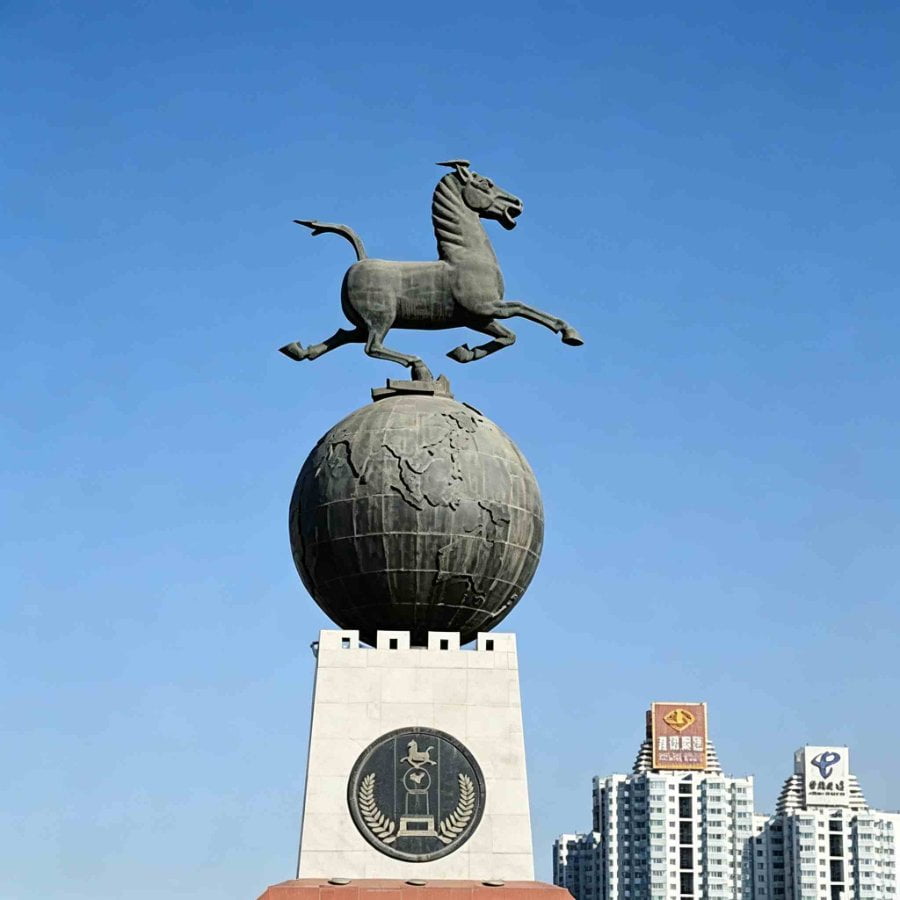
Chinese bronze horse culture reaches its peak in the famous Flying Horse of Gansu7 — a Han Dynasty sculpture so perfectly balanced it stands on a single hoof atop a swallow mid-flight. It is not merely beautiful. It is physically astonishing.
In Chinese feng shui and classical symbolism, the horse represents upward momentum (马到成功 — “the horse arrives, success follows”). Eight horses together — the classic “Eight Steeds” motif — represent complete, unstoppable progress in all directions of fortune.
What’s less discussed is why this works psychologically: a horse in forward motion creates a directional energy that the human eye and nervous system naturally follow8. Placed at the correct orientation, a galloping horse sculpture pulls positive attention — and positive attention, in business and social contexts, tends to generate positive outcomes.
This is not superstition. It’s visual psychology that feng shui practitioners codified long before neuroscience gave it a name.
In Native American Tradition: The Horse as Liberation
Horses arrived in North America with Spanish conquistadors in the 16th century. Within a generation, Plains nations had transformed their entire civilization around the horse9 — and the horse had become the symbol of freedom itself.
For collectors and designers who want their horse sculpture to carry this meaning — liberation, movement, the refusal to be contained — the full-gallop pose with open, unrestrained form communicates it most powerfully.
How to Choose the Right Horse Statue for Your Space
After four decades of client conversations, we’ve developed a simple framework we use internally at YouFine. We call it the Three Questions.
Question 1: What do you want visitors to feel in the first 10 seconds?
Not think. Feel. The visceral, pre-cognitive response.
- Impressed and slightly intimidated? → Rearing horse, over-scale, dark patina
- Energized and forward-moving? → Galloping horse, full extension, warm bronze
- Calm, safe, and welcomed? → Standing or grazing horse, medium scale, natural patina
- Historically anchored and respectful? → Equestrian statue, classical pose, formal base
Question 2: What is the viewing distance?
This is the most neglected factor in horse statue selection.
A life-size horse at 10 meters creates one experience. The same sculpture at 50 meters creates a completely different one — or, if the detail is too fine for the distance, creates almost no experience at all.
As a general rule:
- Under 5 meters: Detail matters most. The quality of casting — muscle definition, texture, expression — is the primary visual language.
- 5 to 20 meters: Pose and silhouette dominate. Choose a pose whose shape reads clearly in profile.
- Over 20 meters: Scale becomes the primary meaning. Go larger than you think you need.
Question 3: Is this for one generation or several?
If you are furnishing a space for a single design cycle, material durability matters less. If you want the sculpture to still be speaking your message in 50 years — to your grandchildren, to future property owners, to the community — bronze is the only serious answer.
We have clients who commissioned horses from YouFine in the 1990s. Those sculptures are still standing, still darkening beautifully with patina, still commanding the spaces they inhabit. No resin garden ornament from 1995 is doing the same.
The Anatomy of a YouFine Life-Size Bronze Horse: What You’re Actually Buying
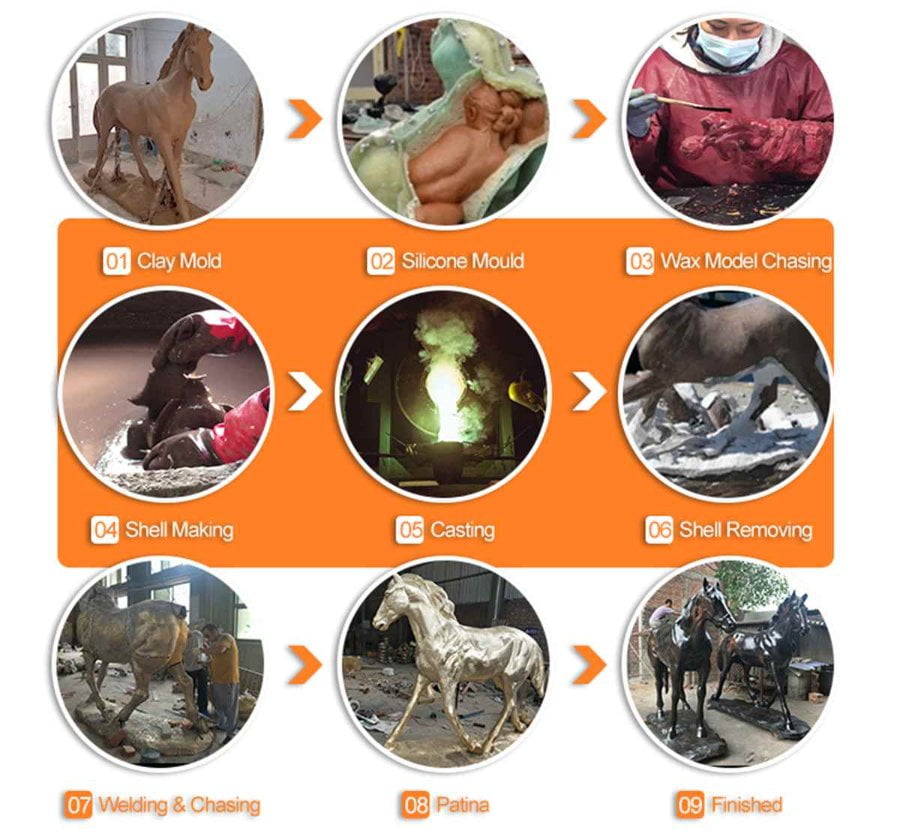
For first-time buyers of monumental sculpture, the process is often mysterious. Here’s how a horse becomes bronze at our foundry in Quyang, China — the stone-carving capital of the world:
- Clay Modeling (1–2 weeks)
Our sculptors begin with anatomical reference: skeletal structure, muscular topology, breed-specific proportions. A horse at life-size scale requires approximately 400–600 kg of clay. Every surface detail is built by hand. - Mold Making (1–3 weeks)
The clay model is used to create a silicone rubber mold, which captures every surface detail including tool marks and texture intentionally left by the sculptor. - Wax Casting (2-4 week)
Molten wax is poured into the mold in layers, creating a hollow wax shell approximately 5–8mm thick — this becomes the wall thickness of the final bronze. - Investment Casting / Lost-Wax Process (2–3 weeks)
The wax shell is encased in ceramic slurry, fired in a kiln (the wax melts away — hence “lost wax”), and molten bronze at 1,100°C is poured into the resulting void. - Assembly and Welding (1–3 weeks)
Large sculptures are cast in sections and welded together by master craftsmen. Weld lines are ground, chased, and textured to be invisible. - Patination (3–5 days)
Chemical patination using liver of sulfur, ferric nitrate, and heat creates the final surface color. Our standard finishes range from warm golden-brown to deep espresso to classical verde antique green. - Structural Engineering (concurrent)
All life-size and larger sculptures are fitted with internal steel armature and base-mounting systems engineered to withstand wind loads appropriate for the installation environment.
Total production time for a life-size horse: 10–16 weeks.
Real Installations: What These Horses Mean in Context
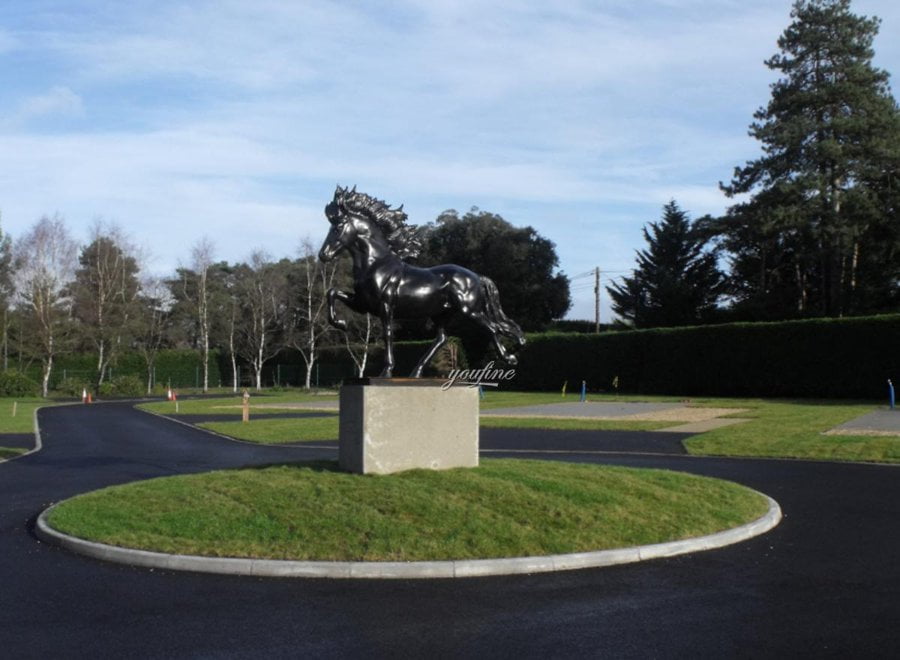
Private Estate Entrance, Southern United States
Commission: A 1.3x life-size galloping horse in dark brown patina, mounted on a 1.2-meter black granite base at the primary entrance gate.
What the client said: “I want anyone who arrives here to understand immediately that this is a working ranch with a 100-year history. Not a hobby farm.”
What the sculpture says without words: We have been running hard for a long time. We have not stopped.
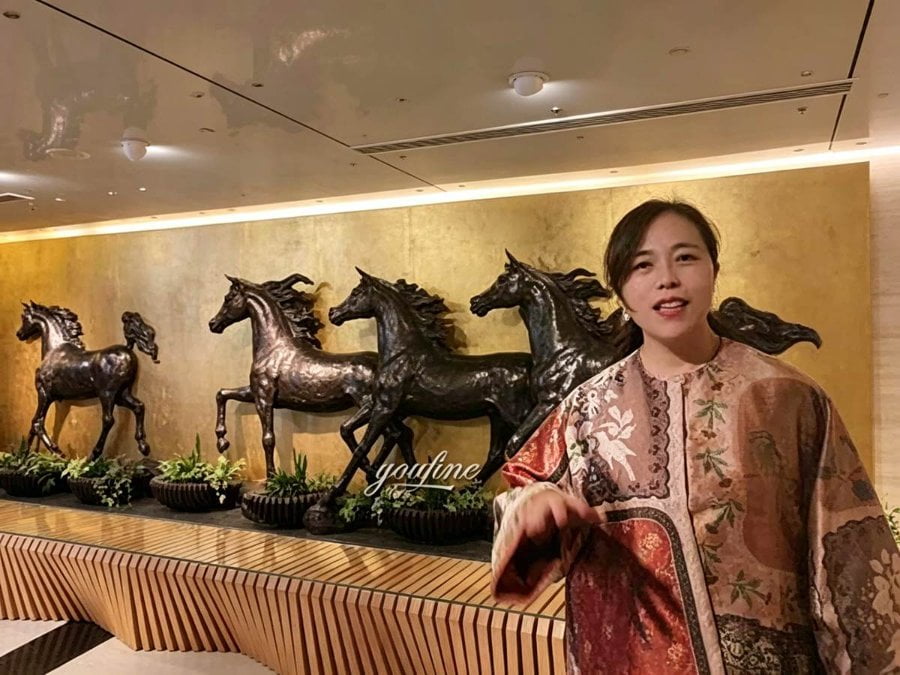
The Frame, Dubai — Lobby Installation Commission
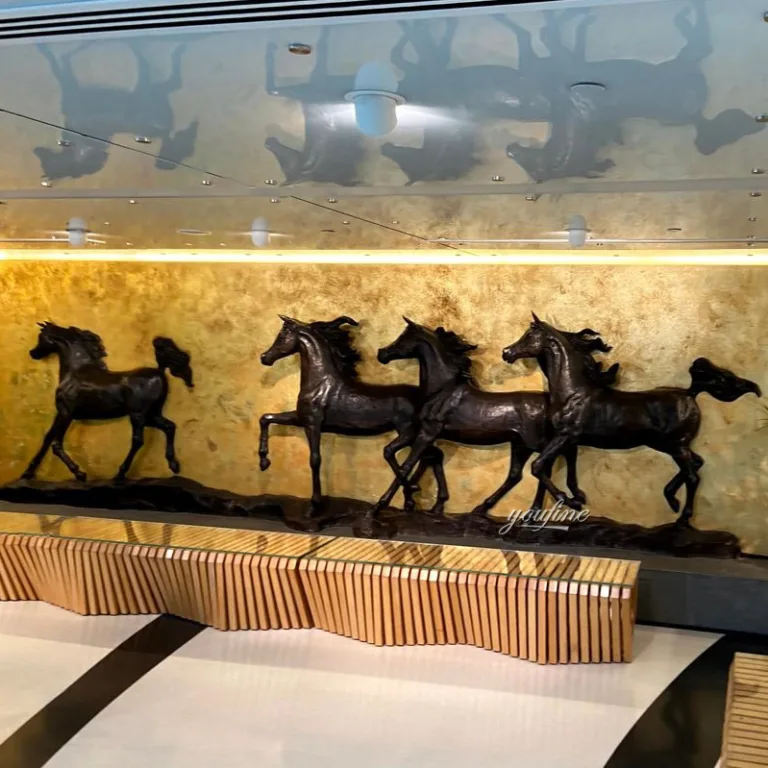
A group of five galloping horses at 0.9x life size, rich dark-brown patina, installed flush against a gold-paneled interior wall at the ground-floor lobby level, framed by living greenery at the base.
What the client said: “Visitors come here from every country in the world. The first thing they see should feel ancient and alive at the same time.”
What the sculpture says: Power does not need to announce itself. It simply moves — and everyone in the room feels it.
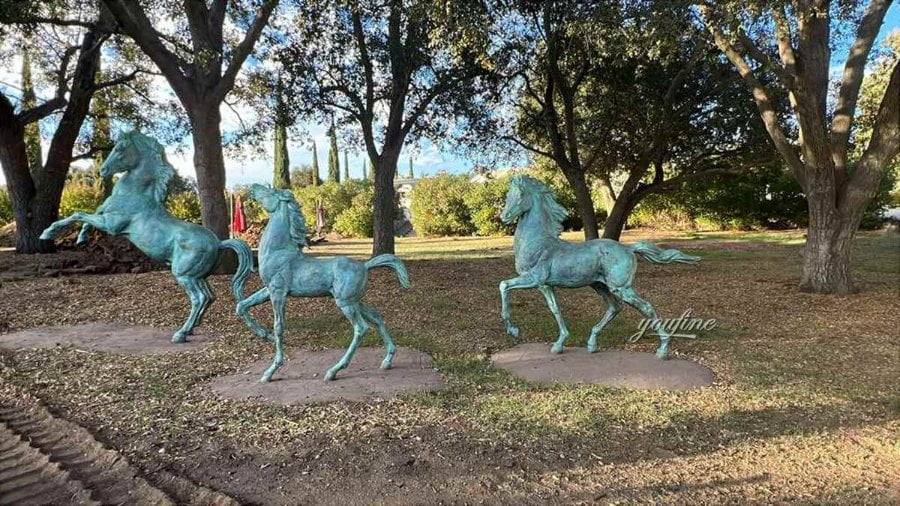
Private Collection, Northern Europe
Commission: Three grazing horses at life size, positioned in a meadow garden.
What the collector said: “I want the garden to feel alive when no one is in it.”
What the sculpture says: Something beautiful is always happening here, whether you are watching or not.
Frequently Asked Questions About Horse Statue Meaning
Does the number of raised hooves really tell you how the rider died?
No. This is a persistent folk legend. Researchers who checked all equestrian statues at Gettysburg found no consistent pattern. The pose of a horse statue carries meaning — but that meaning is about energy, intention, and emotional resonance, not a biographical code.
What does a horse statue at the entrance of a home mean?
Traditionally and across most cultures: power, protection, and forward momentum. The entrance placement specifically communicates that these qualities belong to the space — that what lies beyond the horse is worth guarding.
Is a rearing horse bad luck?
In some feng shui schools, a rearing horse facing outward from a property (toward the street) is said to send energy away rather than attracting it. Facing inward — into the property — it is considered to bring ascending fortune. As with most feng shui principles, intention and context matter more than rigid rules.
What is the best material for an outdoor horse statue?
For long-term outdoor installation, bronze is the clear choice: weather-resistant, structurally stable, and aesthetically enriching over time. Grade A marble is beautiful but vulnerable to freeze-thaw cracking in cold climates. Stainless steel (304 or 316 grade) is an excellent modern alternative with a very different visual statement.
How large should my horse statue be?
As a starting point: the sculpture should be visible and read clearly at the primary viewing distance. If most people will see it from 20+ meters, go to at least life-size. If the viewing is close-range — a courtyard, a study, a garden room — a smaller scale can be more intimate and appropriate.
The Meaning Is Yours to Decide
Every civilization that has ever cast, carved, or painted a horse has projected onto it the thing they most needed to believe about themselves.
Speed. Strength. Freedom. Loyalty. Victory. Persistence. The will to keep moving.
The meaning of a horse statue is not determined by legend or by the position of its hooves. It is determined by the conversation between the sculpture, the space, and the person who stands before it.
At YouFine, our job is not to tell you what your horse statue should mean. It is to give you the craftsmanship, the scale, and the material permanence to say it clearly — and to keep saying it long after we are gone.
If you are considering a life-size or custom bronze horse for your property, estate, or public installation, we would welcome the conversation.
Request a Free Consultation and Custom Design Proposal →
YouFine Sculpture has been handcrafting life-size bronze figures since 1983. Our foundry is located in Quyang, Hebei Province, China — the UNESCO-recognized stone carving capital of the world. All sculptures are produced using traditional lost-wax casting methods by master craftsmen with 20+ years of experience.
- Greenberg, J. (2018, October 26). No, equestrian statues don’t have a secret ‘code of hooves’. PolitiFact. ↩︎
- Mikkelson, D. (1998, updated). Equestrian Statue Code. Snopes. ↩︎
- American Museum of Natural History. Thoroughbred. AMNH Ology — All About Horses. ↩︎
- Wikipedia contributors. Patina. Wikipedia, The Free Encyclopedia. ↩︎
- Mattusch, C. C. The Technique of Bronze Statuary in Ancient Greece. The Metropolitan Museum of Art. ↩︎
- Wikipedia contributors. Equestrian statue of Marcus Aurelius. Wikipedia, The Free Encyclopedia. ↩︎
- Wikipedia contributors. Flying Horse of Gansu. Wikipedia, The Free Encyclopedia. ↩︎
- Friesen, C. K., & Kingstone, A. (2014). Reflexive Orienting in Response to Short- and Long-Duration Gaze Cues. PLOS ONE / PMC. ↩︎
- Katz, B. (2023, April 3). New Research Rewrites the History of American Horses. Smithsonian Magazine. ↩︎