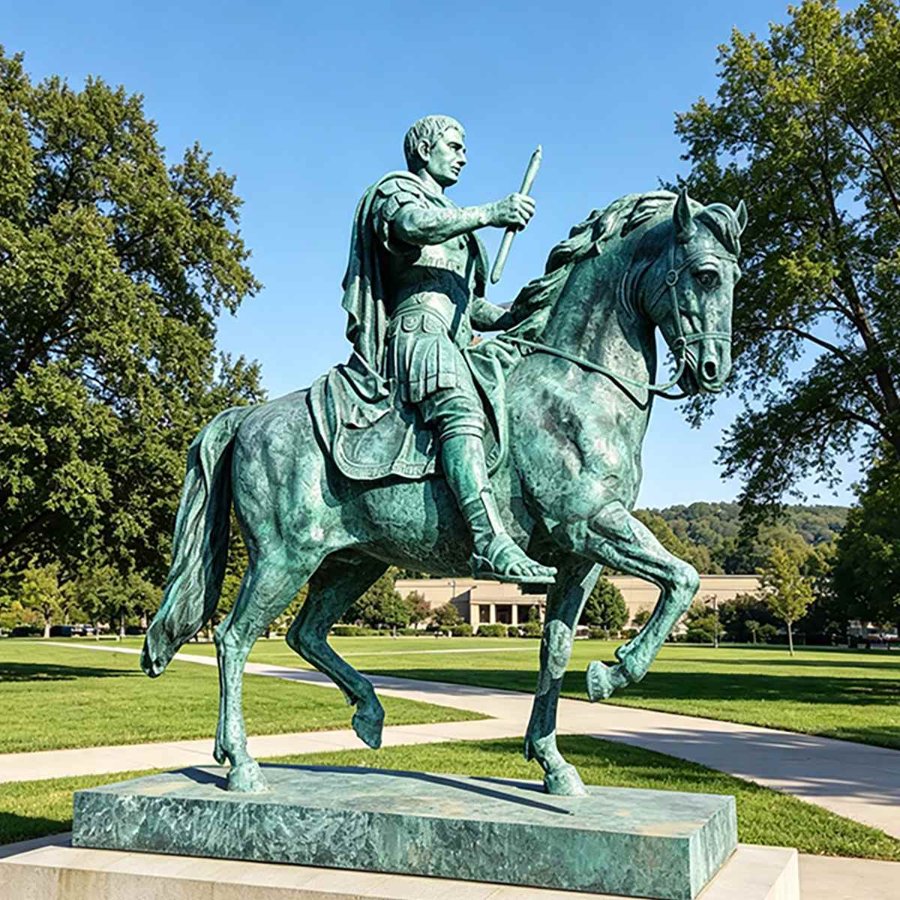
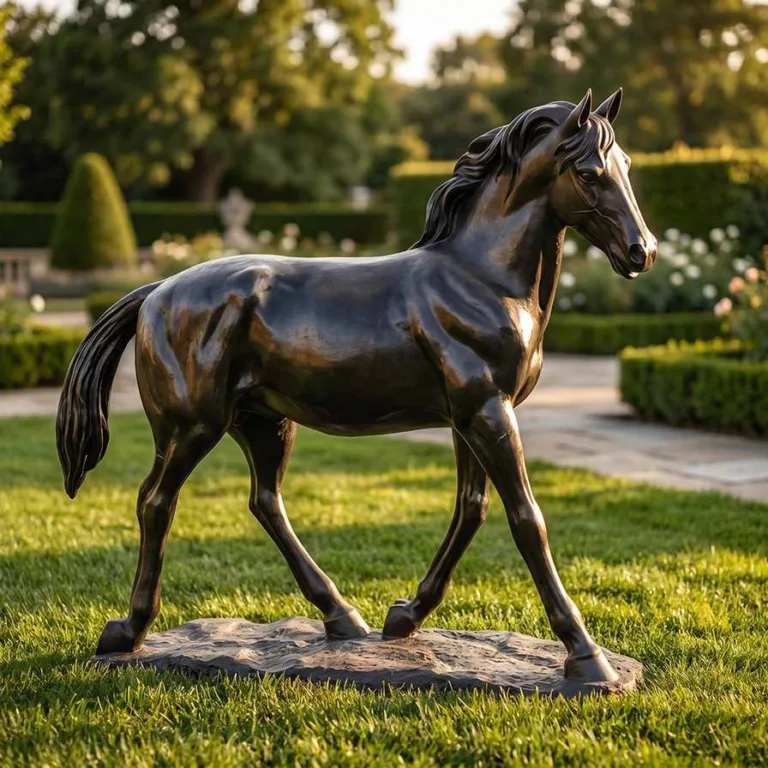
21 Famous Horse Statues Around the World: A Foundry’s Guide to the Horse Sculptures
From a Roman bronze that survived by mistake to 30-metre steel horses in Scotland — 21 of the world’s most famous horse statues, explained by people who cast them for a living.
There are thousands of horse statues standing in public squares, parks and racetracks around the world. Only a handful are genuinely famous — and fame, it turns out, is rarely about size alone.
We have been casting and exporting large-scale bronze horses since 1983. That gives us a slightly different way of reading these monuments. Where a travel guide sees a rearing stallion, we see a balancing problem that took a foundry team months to solve. Where a history book records a date, we see the moment a casting technique was recovered after a thousand years of being lost.
This guide covers 21 of the most famous horse statues in the world, organised into five families by what they were made to do rather than by where they happen to stand. Each entry includes the sculptor, the date, the material and — where it matters — a short note on how the piece was actually built. At the end you will find a single comparison table covering all 21, a straight answer to the persistent “hoof code” myth, and a practical section on how bronze, copper and steel age once they are outdoors.
How We Chose These 21: The 4-Dimension Fame Framework
Most lists of famous horse statues are assembled by popularity. We wanted something more defensible, so we scored candidates against four dimensions. A statue had to be strong in at least three of them to make the list.
1. Historical Weight
Did the work change something? Donatello’s Gattamelata did not just commemorate a mercenary captain — it restarted an entire art form. A statue with historical weight is one that art historians still argue about.
2. Sculptural Difficulty
This is the dimension almost no other list considers, and it is the one we know best. A horse standing on four legs is a straightforward casting job. A horse rearing on two, or galloping with all four hooves off the ground, is a structural engineering problem disguised as art. Difficulty covers the number of sections a piece had to be cast in, how the internal armature carries the load, and whether the sculptor was attempting something nobody had solved before.
3. Cultural Reach
How far did the image travel beyond the plinth? Copies, banknotes, national logos, film references, tourist volume. The Flying Horse of Gansu scores extraordinarily high here — it became the official emblem of Chinese tourism.
4. Survival and Rarity
Bronze is valuable, and for most of history that made bronze statues fuel for cannon. Surviving for centuries usually required luck as much as care. The rarest works on this list are rare because of specific, often accidental, reasons — and those stories are frequently the most interesting thing about them.
The Five Families of Famous Horse Statues
Almost every existing article on this subject presents a flat, unsorted list. That is a missed opportunity, because horse sculpture divides very naturally by intent — and intent is also how designers and project buyers actually search for a reference.
Family
What defines it
Statues
1. Imperial & Heroic Equestrian Monuments
A rider is present; the subject is power, command or martyrdom
5
2. Mythic & Chariot Horses
Gods, legends, water-spirits and multi-horse chariot groups
4
3. Riderless & Wild Horses
No rider; the horse itself is the subject
4
4. Champion & War Horse Memorials
Commemorating one specific, named animal
4
5. Modern & Monumental Bronze Horses
Twentieth-century and contemporary works defined by scale or abstraction
4
A note on terminology before we start: an equestrian statue specifically means a horse with a rider. A horse statue is the broader term and includes riderless works. Families 3 and 4 below are horse statues but not equestrian statues — a distinction that catches out a surprising number of published lists.
Family 1 — Imperial and Heroic Equestrian Monuments
These are the works that define the genre. All five are bronze, and four of the five were cast by foundries working at the absolute limit of what their era could do.
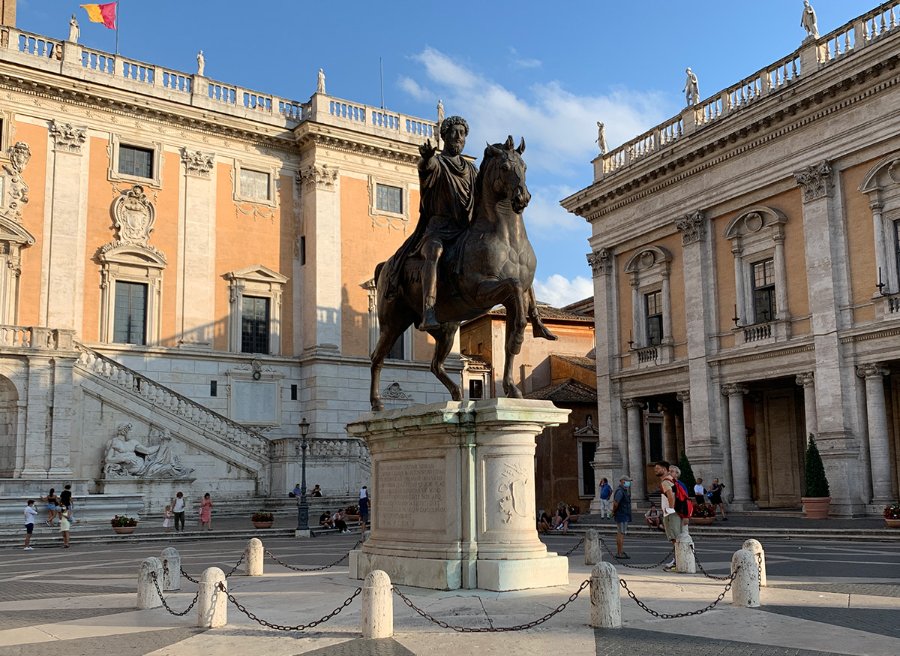
1. Equestrian Statue of Marcus Aurelius — Rome, Italy
Sculptor: Unknown · Date: c. 175 AD · Material: Gilded bronze · Location: Capitoline Museums, Rome (replica on the Piazza del Campidoglio)
This is the ancestor of every other statue on this list. Cast around 175 AD, it is the only fully intact bronze equestrian statue to survive from ancient Rome — and it survived by mistake. Throughout the medieval period, bronzes of pagan emperors were systematically melted down. This one was spared because it was misidentified as Constantine, the first Christian emperor. A clerical error saved the single most important equestrian sculpture in Western art.
Michelangelo placed it at the centre of his redesigned Piazza del Campidoglio in 1538, making it the focal point of one of the most celebrated urban spaces in Europe. The original was moved indoors in 1981 to protect it from air pollution; what visitors photograph today is a faithful replica.
The emperor rides without stirrups — they had not yet reached Rome — and extends his right hand in a gesture of clemency rather than conquest. Traces of the original gold leaf are still visible on the surface.
Foundry note: The Marcus Aurelius was cast in multiple sections using the lost-wax method and joined by fusion welding, with wall thicknesses varying deliberately to control the centre of gravity. The horse’s raised foreleg is the entire technical argument of the piece. Nearly nineteen centuries later, we still cast a life-size horse in twelve to eighteen separate sections for exactly the same reason — a single monolithic pour of that mass would crack as it cooled.
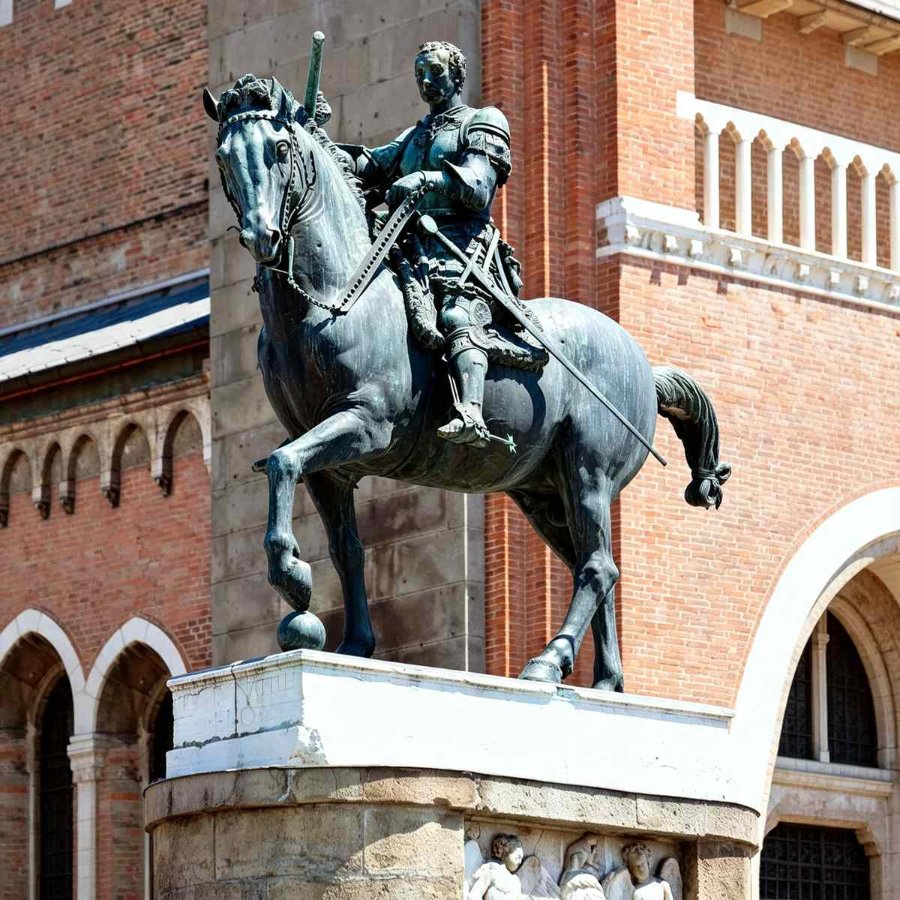
Donatello’s monument to the condottiero Erasmo da Narni, nicknamed Gattamelata, was the first life-size equestrian statue cast in bronze since classical antiquity. That single fact is why it appears on every serious list.
Consider what it required. The technique had been effectively dormant for roughly a thousand years. There was no living craftsman who had done it. Donatello and his foundry had to reconstruct large-scale bronze casting from surviving Roman examples and first principles — and they got it right on a commission that took six years.
The composition is deliberately restrained. The horse walks; it does not rear. Gattamelata carries a commander’s baton rather than a raised sword. Donatello was making a case that a professional soldier deserved the visual language previously reserved for emperors, and he made it in a calm, unhurried register that turned out to be far more persuasive than bombast.
Foundry note: Look at the horse’s raised left foreleg — it rests lightly on an orb. That orb is not decoration. It is a load-bearing support disguised as a symbol, and it is one of the oldest and most elegant solutions to the rearing-horse problem in the history of the craft.
A magnificent bronze equestrian Gattamelata statue set against a historic Italian architectural backdrop.
3. Equestrian Statue of Bartolomeo Colleoni — Venice, Italy
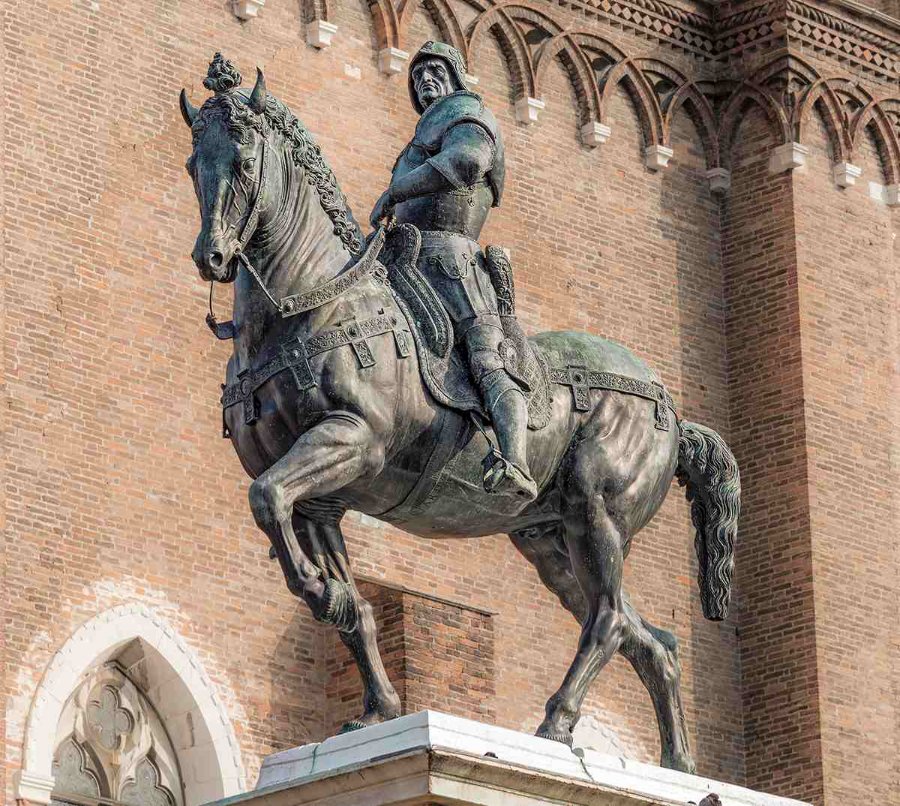
Sculptor: Andrea del Verrocchio · Date: 1480–1488 · Material: Bronze · Location: Campo Santi Giovanni e Paolo, Venice
If Gattamelata is the calm argument, the Colleoni is the shout. Verrocchio — Leonardo da Vinci’s teacher — spent eight years on this monument and died before it was cast.
Where Donatello’s horse walks evenly, Verrocchio’s is caught mid-stride with the near foreleg lifted and the whole mass twisted slightly off-axis. Colleoni stands in his stirrups, shoulders rotated, jaw set. The two statues are separated by only thirty-five years and about twenty-five miles, and comparing them is the single best way to understand what the Renaissance did to sculpture.
The commission itself is a Venetian joke. Colleoni left his fortune to the Republic on condition that a monument be raised to him in the Piazza San Marco. Venice took the money and put the statue in the square of San Marco’s confraternity instead — a technically compliant answer to a request the Republic had no intention of honouring.
Foundry note: The Colleoni horse’s off-axis torsion is what makes this a hard cast rather than merely a large one. Twisting the mass moves the centre of gravity out over the supporting legs, which multiplies the stress at the ankle joints. Verrocchio was solving in 1488 the same problem we solve today with a hidden internal steel core running from hoof to shoulder.
Bronze equestrian statue of Bartolomeo Colleoni, a knight on a horse, displayed in front of a brick building.
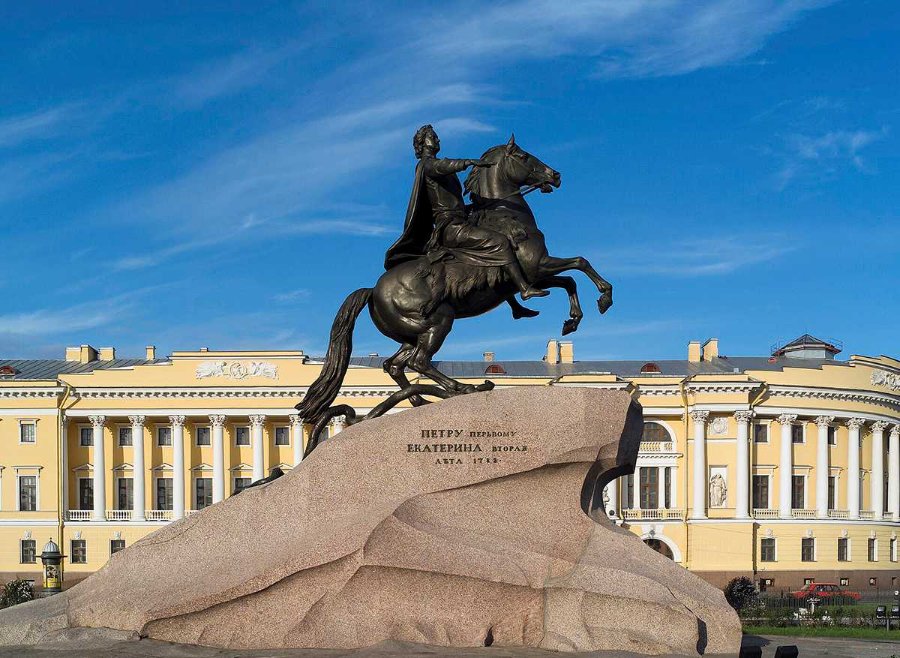
4. The Bronze Horseman (Peter the Great) — Saint Petersburg, Russia
Sculptor: Étienne Maurice Falconet · Date: 1768–1782 · Material: Bronze on the Thunder Stone · Location: Senate Square, Saint Petersburg
Commissioned by Catherine the Great and unveiled in 1782, The Bronze Horseman is the defining image of Saint Petersburg — largely thanks to Pushkin’s 1833 poem of the same name, which gave the statue a second life as a literary character.
Peter’s horse rears over a serpent representing treachery, and the whole composition rests on the Thunder Stone: a single glacial boulder that remains one of the largest stones ever moved by human beings. Transporting it roughly six kilometres overland to the Gulf of Finland required a purpose-built system of bronze spheres running in metal-lined channels, and hundreds of men working for months. The base is arguably a greater feat of logistics than the statue is of casting.
Foundry note: A rearing horse supported on only its hind legs and tail is one of the hardest configurations in the discipline. The serpent beneath the rear hooves provides a discreet third point of contact, transferring load to the plinth. Falconet’s team also cast the front section with deliberately thinner walls than the rear to shift mass backwards over the supports — the same weight-distribution logic we still apply when a client asks for a fully rearing life-size bronze.
The iconic Bronze Horseman statue of Peter the Great in Saint Petersburg, Russia, symbolizing strength and leadership.
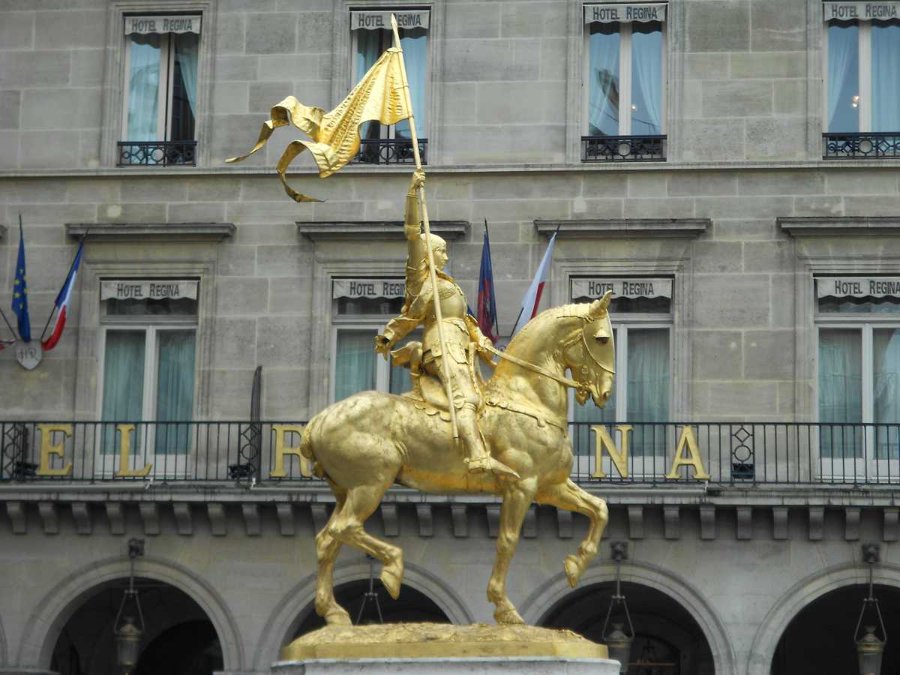
5. Jeanne d’Arc — Paris, France
Sculptor: Emmanuel Frémiet · Date: 1874 · Material: Gilded bronze · Location: Place des Pyramides, Paris
Frémiet’s gilded Joan of Arc stands close to where she was wounded during the 1429 assault on Paris. Erected in 1874, three years after France’s defeat in the Franco-Prussian War, it was never simply a historical monument — it was a rallying image for a nation rebuilding its self-image.
What makes it sculpturally notable is the armour. Frémiet was an obsessive researcher of both animal anatomy and historical equipment, and the detailing of Joan’s plate armour and the horse’s harness was unusually rigorous for its period. The gilding keeps the figure legible against the grey Paris stone in almost any light, which is precisely why it photographs as well as it does.
Foundry note: Gilded bronze behaves differently outdoors from patinated bronze. The gold layer seals the surface against the atmosphere, so the metal underneath never develops the green carbonate patina — but the gilding itself wears and requires periodic reapplication. It is a maintenance commitment, not a one-time finish.
The gilded equestrian Jeanne d’Arc statue prominently displayed in front of Hotel Regina.
Family 2 — Mythic and Chariot Horses
Horses in this family are not portraits. They are gods, legends and symbols — and they include some of the most ambitious metalwork ever attempted.
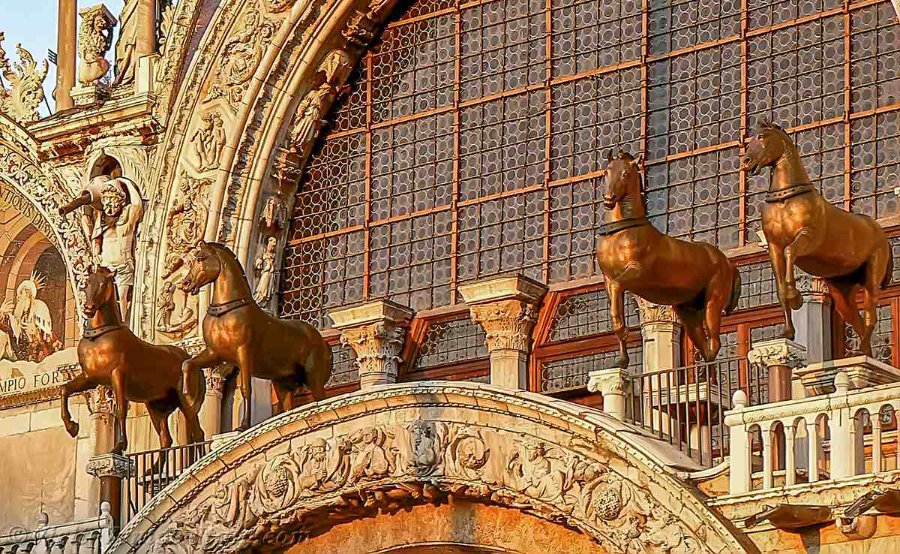
6. The Horses of Saint Mark — Venice, Italy
Sculptor: Unknown, Classical antiquity · Date: Contested; 2nd–4th century AD · Material: Gilded copper alloy · Location: St Mark’s Basilica Museum, Venice (replicas on the loggia)
Four horses, one chariot group, and the most travelled sculpture in Europe. The Triumphal Quadriga probably stood in Constantinople’s Hippodrome before Venetian forces looted it during the Fourth Crusade in 1204. Napoleon took them to Paris in 1797; they returned to Venice in 1815. They were removed for safekeeping during both World Wars, and finally moved indoors in the 1980s because of atmospheric corrosion.
Their metallurgy is unusual and revealing. The alloy is exceptionally high in copper — well above typical classical bronze. That composition is much harder to cast cleanly, and the most credible explanation is that the makers accepted the difficulty because a high-copper surface takes mercury gilding far more successfully. They chose the harder casting job to get the better finish.
Foundry note: The visible scoring across the horses’ coats is not damage or age. It is deliberate hatching, cut to break up reflections on the gilded surface so the forms stay readable from ground level. This is a lesson still worth applying: a highly reflective finish on a large outdoor piece will flatten out visually unless the surface is broken up.
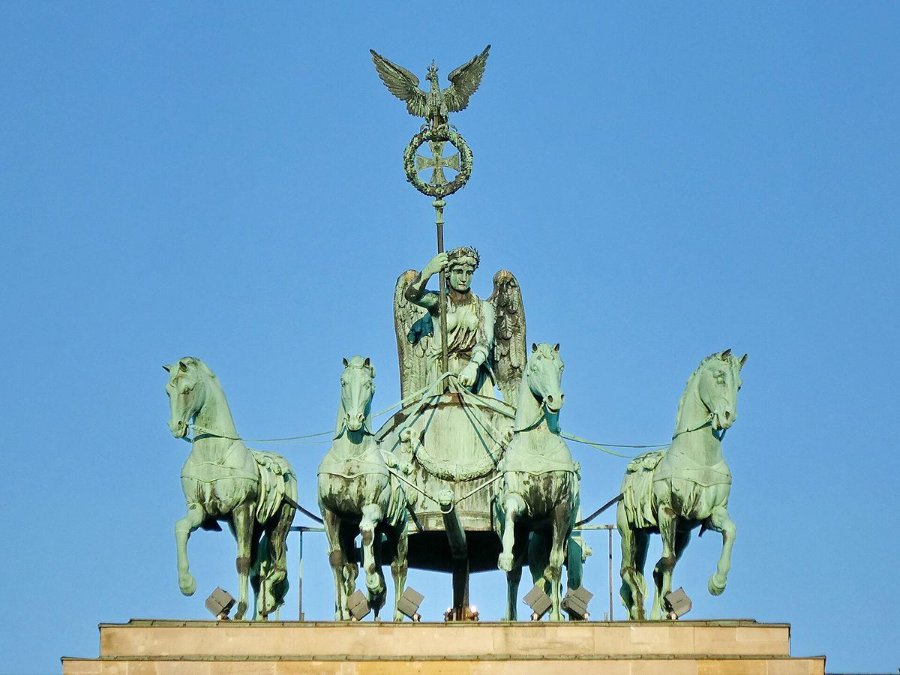
7. The Quadriga of the Brandenburg Gate — Berlin, Germany
Sculptor: Johann Gottfried Schadow · Date: 1793 · Material: Hammered copper over a wooden core · Location: Brandenburg Gate, Berlin
Four horses drawing the chariot of the goddess of victory, mounted on top of Berlin’s most recognisable structure. Schadow completed it in 1793, standing roughly 5.5 metres tall.
Its history is inseparable from Europe’s. Napoleon seized it in 1806 and shipped it to Paris; it was recovered in 1814, and on its return Prussia added an iron cross to the goddess’s staff — the moment the figure was reinterpreted from a peace-bringer into a victory monument. The original was destroyed in the Second World War, and only a single horse’s head survived, now held in Berlin. The Quadriga standing on the gate today was recreated in 1958 from plaster casts made before the war.
Foundry note: This is repoussé — sheet copper hammered over a form — not casting. That is why it could be built at 5.5 metres in 1793 and still be light enough to sit on a gate structure. It is also why so little of it survived bombing. Cast bronze of the same dimensions would have weighed several times more and needed a completely different roof structure beneath it.
The iconic Quadriga sculpture crowns the Brandenburg Gate in Berlin, symbolizing victory and unity.
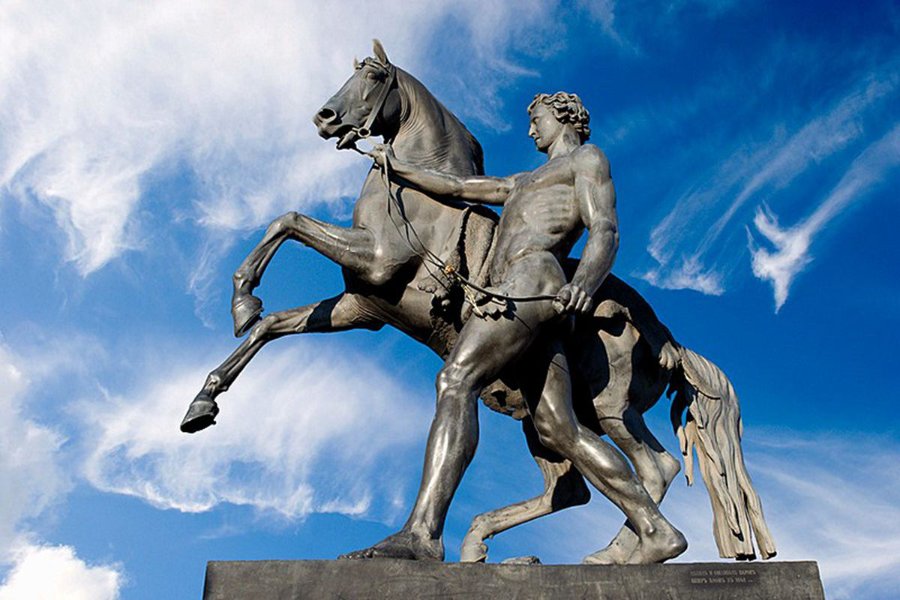
8. The Horse Tamers of the Anichkov Bridge — Saint Petersburg, Russia
Four bronze groups, one at each corner of the bridge, showing a man progressively mastering a wild horse. Read clockwise, they form a narrative sequence: the horse rears free, the man is dragged, the struggle turns, and finally the animal is led calm and submitting.
Klodt spent a decade on the series and cast them in his own foundry — unusual for a sculptor of his standing, and the reason the surface quality is so consistent across all four groups. The set is a genuinely rare thing: a multi-part public sculpture that has to be walked around to be understood.
Foundry note: Making four separate groups read as one continuous sequence requires the horses to share exact anatomical proportions while holding entirely different poses. Klodt worked from a single master anatomical study and rebuilt each pose from it — the same discipline behind any modern set of matched sculptures intended for one site.
Bronze Horse Tamers sculpture of a man and a rearing horse, symbolizing strength and control.
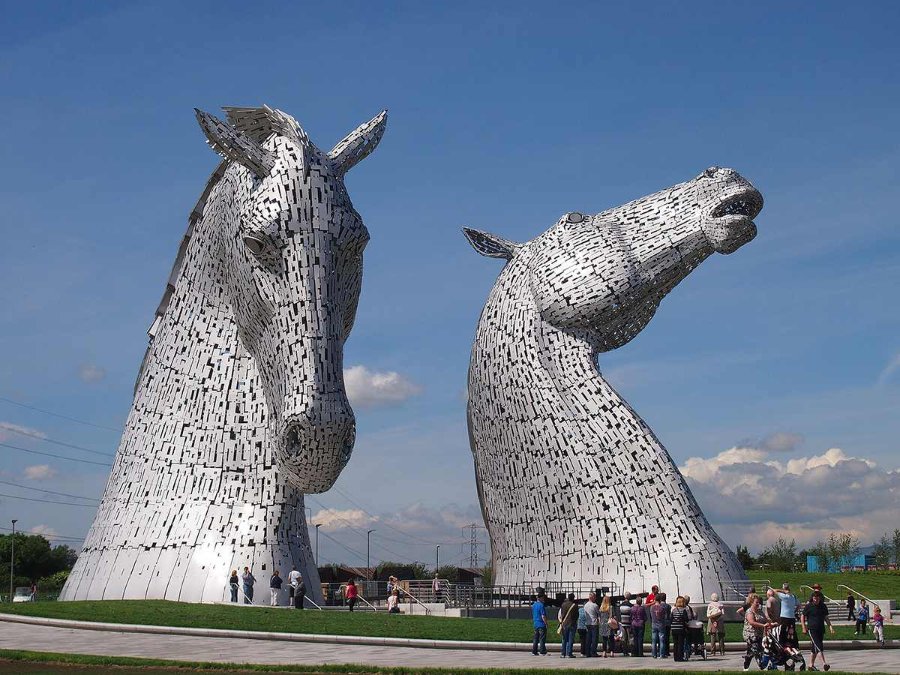
9. The Kelpies — Falkirk, Scotland
Sculptor: Andy Scott · Date: Completed 2013 · Material: Structural steel with stainless steel cladding · Location: The Helix, Falkirk
Two horse heads, each 30 metres high, rising out of the Scottish lowlands. The Kelpies takes its name from the shape-shifting water spirits of Scottish folklore, but the sculptural subject is a specific and unromantic thing: the heavy working horses that pulled barges along Scotland’s canals and wagons through its industrial heartland.
Andy Scott modelled them on two living Clydesdales, Duke and Baron. The finished heads are built as steel armatures clad in hundreds of individually shaped plates, and the whole structure sits on substantial concrete foundations. They are among the largest equine sculptures anywhere in the world.
Foundry note: At this scale, casting is simply not an option — the piece is fabricated, not poured. Scott’s team worked from a 1:10 maquette that was 3D-scanned, with the digital model then used to cut every plate. It is a fundamentally different discipline from bronze casting, and it is the honest reason we place a steel work in a list otherwise dominated by bronze: above roughly 15 metres, the material has to change.
The Kelpies, iconic horse head sculptures in Scotland, attract numerous visitors daily.
Family 3 — Riderless and Wild Horses
Remove the rider and the sculptor loses every prop that normally carries the meaning — no uniform, no sword, no baton. Everything has to be said through the animal itself. These four are the works that prove it can be done.
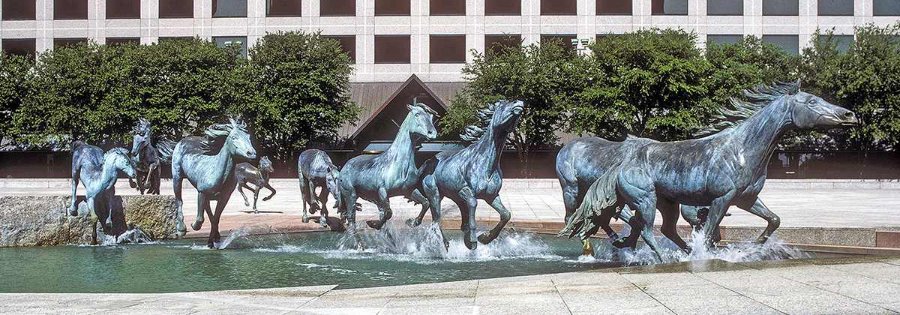
10. The Mustangs of Las Colinas — Irving, Texas, USA
Sculptor: Robert Glen · Date: Installed 1984 · Material: Bronze · Location: Williams Square, Las Colinas, Irving
Nine wild mustangs at one and a half times life size, galloping across a granite watercourse. Robert Glen worked on the commission for around seven and a half years, and the result is widely regarded as one of the finest groups of equine sculpture in the world.
The decisive detail is the water. Small jets set into the granite fire upward at each hoof as it strikes, so the horses appear to be splashing through a running stream. Remove the fountain and it is a very good sculpture. With it, the piece becomes kinetic — the illusion of a herd in motion across an open plaza.
Glen’s subject was the wild mustang herds that ran across Texas before European settlement, and the choice of nine loose, unformed animals rather than a tidy row is exactly the point.
Foundry note: Nine horses at 1.5× life size, each caught at a different phase of the gallop, means nine separate armature solutions — some animals have only one hoof in contact with the base. Groups like this are engineered backwards: you establish the anchor points and load paths first, then let the sculptor pose within those constraints. The fountain jets also mean permanent water exposure, which makes alloy selection and internal drainage a serious durability question rather than a detail.
Bronze Mustangs of Las Colinas in motion within a water feature, symbolizing strength and freedom.
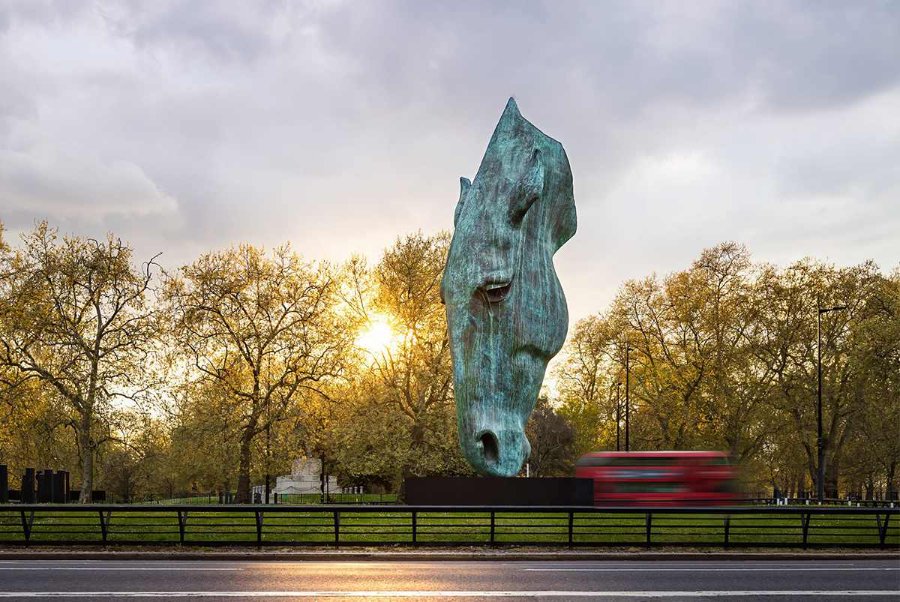
11. Still Water — London, United Kingdom
Sculptor: Nic Fiddian-Green · Date: Installed 2011 · Material: Bronze · Location: Marble Arch, London
A horse’s head, 10 metres tall, lowered as if drinking. Still Water is the largest free-standing bronze sculpture in London, and it works by inversion: monumental scale used to express stillness rather than power.
Fiddian-Green has built a career on the horse’s head as a subject, tracing the motif back to the Parthenon’s Selene horse. Placing a colossal bronze head in a downward, drinking posture at one of London’s busiest traffic intersections was a genuine risk, and it paid off — the piece has become a landmark in a location that had defeated several previous attempts at public art.
Foundry note: A lowered head is deceptively difficult. The mass sits forward of the neck’s base, so the load wants to tip. The whole structure is resolved through the internal armature and the ground anchoring rather than anything you can see. This is worth noting for anyone commissioning a large piece: the more relaxed and natural a heavy sculpture looks, the more engineering is usually hidden inside it.
A monumental bronze horse head sculpture installed in a park at sunset, with a red double-decker bus passing in the foreground.
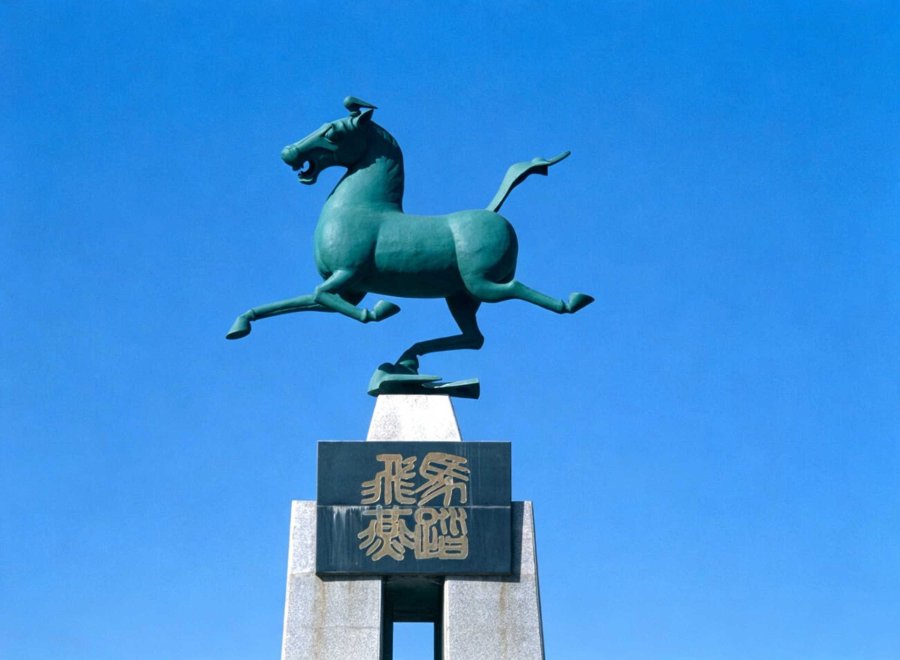
12. The Flying Horse of Gansu — Lanzhou, China
Sculptor: Unknown · Date: c. 2nd century AD, Eastern Han dynasty · Material: Bronze · Location: Gansu Provincial Museum, Lanzhou
Small enough to hold, and one of the most reproduced horse sculptures on earth. Excavated in 1969 from a tomb at Leitai in Wuwei, the Bronze Galloping Horse is shown at full extension with three legs in the air and one hoof touching down on the back of a flying bird — the only point of contact with the base.
That is the entire idea. A Han dynasty foundry solved the problem of depicting weightless speed by giving the horse a single support and making that support itself a symbol of flight: the horse is faster than a bird. It was adopted as the official emblem of Chinese tourism, which is a fair measure of its cultural reach.
Foundry note: Balancing a bronze horse on one hoof requires the centre of gravity to fall precisely over that single contact point — and it must be achieved during modelling, because you cannot correct it after casting. Two thousand years on, this remains a piece our own workshop studies. The engineering is more sophisticated than the object’s modest size suggests.
A bronze Flying Horse of Gansu displayed on a pedestal with engraved text, symbolizing strength and heritage.
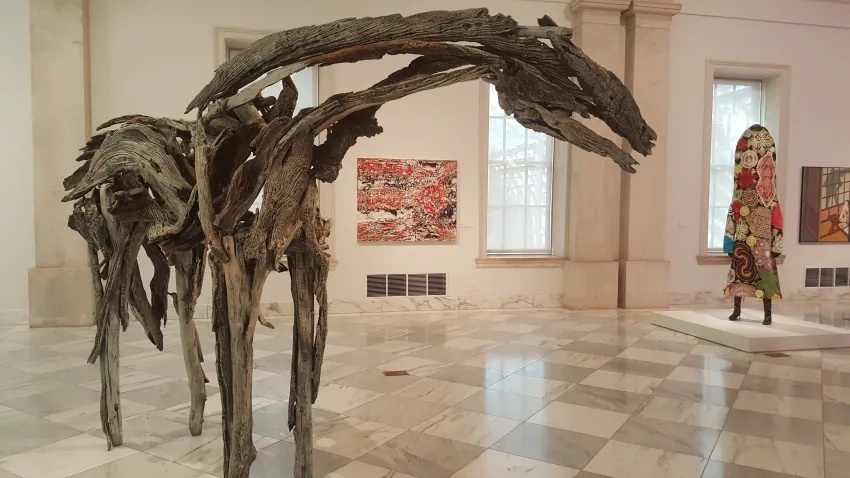
13. Monekana — Washington, D.C., USA
Sculptor: Deborah Butterfield · Date: 2001 · Material: Cast bronze · Location: Smithsonian American Art Museum, Washington, D.C.
At a distance it looks like a horse assembled from driftwood and storm debris. It is bronze — every piece of it.
Butterfield’s method is a direct inversion of normal practice. She builds the horse from found wood, then casts each individual branch in bronze through lost-wax, reassembles the metal pieces, and applies a patina that reproduces the grain, splits and weathering of the original timber. The finished sculpture is a bronze that has spent enormous effort convincing you it is not bronze.
Her horses are also consistently gentle in posture — standing, grazing, resting — which is unusual in a field dominated by rearing and charging animals.
Foundry note: This is the most demanding patina work on the entire list. Reproducing weathered wood in metal means controlling colour, sheen and texture differently across every single branch. Ordinary patination is applied to a whole surface at once; this has to be built up locally, area by area. It is the clearest demonstration we know that in bronze, the finishing stage is not decoration — it is where the work is either won or lost.
A striking Monekana horse sculpture displayed in an art gallery.
Family 4 — Champion and War Horse Memorials
These commemorate one specific animal. That changes the sculptor’s job entirely: the piece has to be recognisable to people who knew the horse, which makes it portraiture with all the accountability that implies.
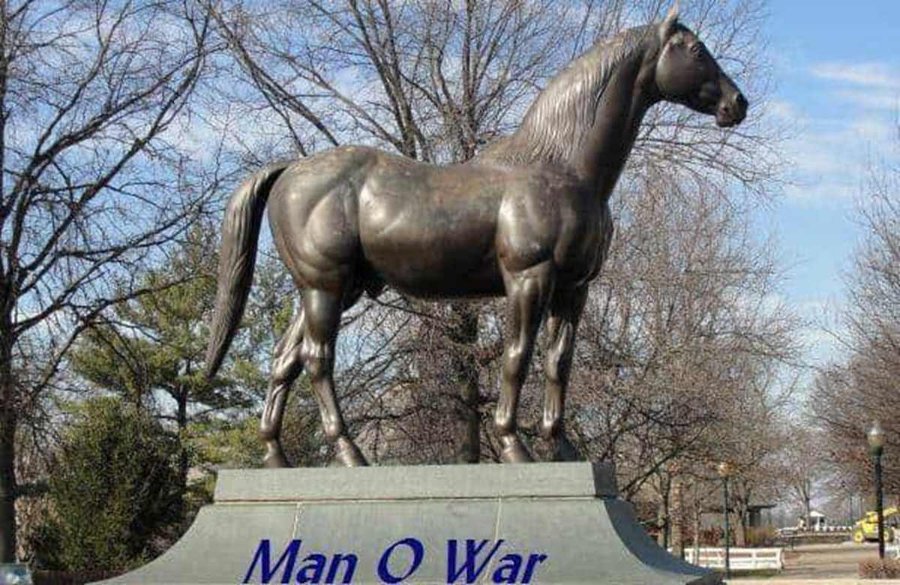
14. Man o’ War — Kentucky Horse Park, Lexington, USA
Sculptor: Herbert Haseltine · Date: Dedicated 1948 · Material: Bronze · Location: Kentucky Horse Park, Lexington, Kentucky
Herbert Haseltine’s Man o’ War is the archetype of the American champion memorial. Dedicated in 1948 at Faraway Farm and later relocated to the Kentucky Horse Park, it stands over the horse’s grave — one of the few sculptures on this list that also functions as a headstone.
Haseltine sculpted the horse at slightly larger than life size, standing at rest rather than in motion. That was a considered choice. Man o’ War’s reputation was built on overwhelming speed, and the obvious approach would have been to show him running. Haseltine instead presents a great athlete standing still, letting conformation and bearing carry the argument.
Foundry note: Portrait sculpture of a specific animal is judged by people who remember it. Haseltine worked from photographs, measurements and direct observation, and the standing pose gives the viewer time to check the anatomy — which is precisely why an artist has to be confident to choose it.
Bronze statue of Man o’ War, a renowned racehorse, displayed outdoors.
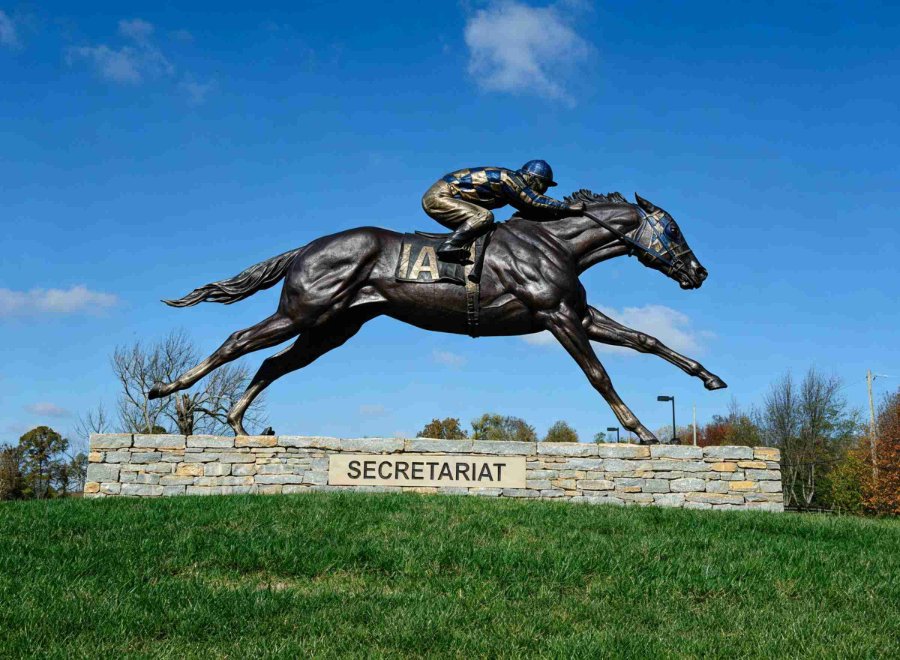
15. Secretariat — Kentucky Horse Park, Lexington, USA
Sculptor: Jim Reno · Date: 20th century · Material: Bronze · Location: Kentucky Horse Park, Lexington, Kentucky
Secretariat’s 1973 Belmont Stakes — a Triple Crown sealed by a 31-length margin — is the single most famous performance in American racing. Jim Reno’s bronze at the Kentucky Horse Park is the best-known memorial to the horse, and it draws visitors who have no particular interest in sculpture and considerable interest in Big Red.
It illustrates something worth noting: for a champion memorial, the audience arrives already emotionally invested. The sculpture does not have to create feeling. It has to avoid disappointing feeling that already exists — a narrower and less forgiving brief than it sounds.
A striking bronze statue of Secretariat commemorates the legendary racehorse.
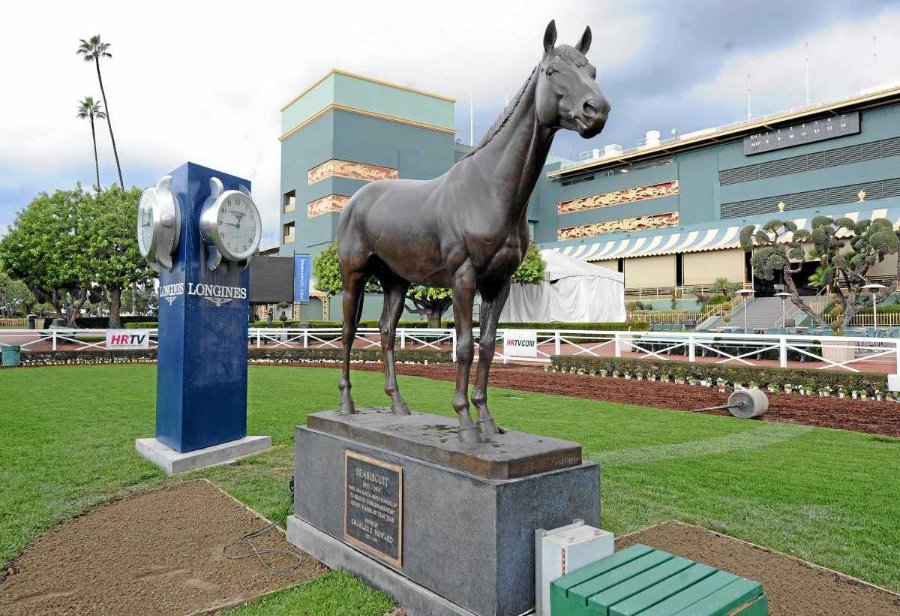
16. Seabiscuit — Santa Anita Park, Arcadia, California, USA
Sculptor: Hughlette “Tex” Wheeler · Date: 20th century · Material: Bronze · Location: Santa Anita Park, Arcadia, California
Seabiscuit was the Depression-era underdog who became one of the most followed athletes in America. Tex Wheeler’s life-size bronze at Santa Anita commemorates the horse at the track most associated with his career, and a second cast of the work stands elsewhere.
The sculpture matters because of what Seabiscuit represented rather than his conformation. He was famously unimpressive to look at — small, knobbly-kneed, awkward. A sculptor flattering the subject would have missed the story entirely. Wheeler did not flatter him.
A bronze Seabiscuit horse statue at a racecourse, symbolizing heritage and strength, placed next to a prominent Longines clock display.
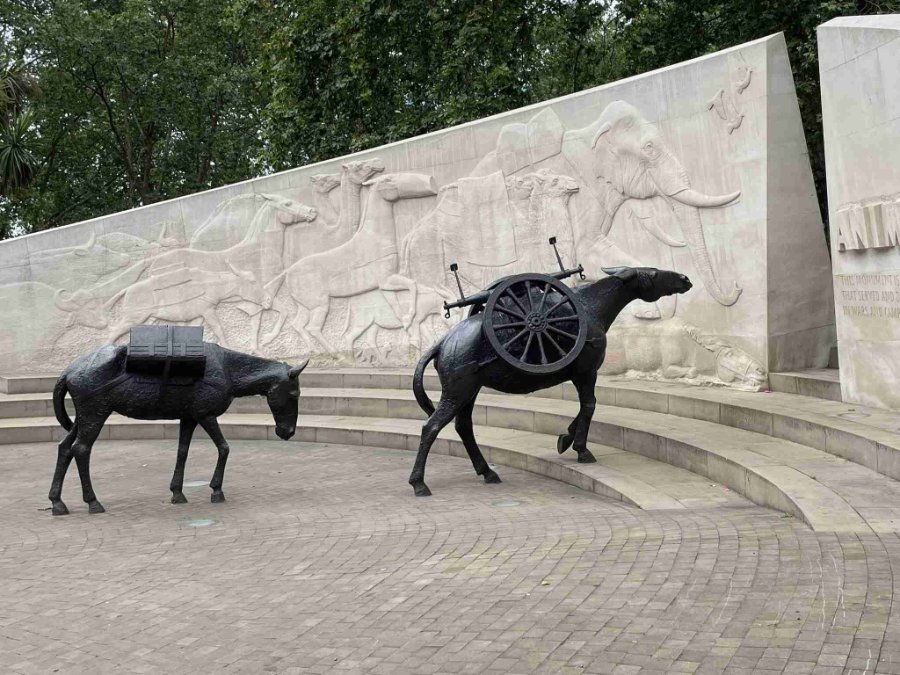
17. The Animals in War Memorial — London, United Kingdom
Sculptor: David Backhouse · Date: Unveiled 2004 · Material: Bronze figures with a Portland stone wall · Location: Park Lane, Hyde Park, London
Not a single statue but a composed memorial: a curved Portland stone wall roughly 70 feet long, carved with the animals that served in twentieth-century conflicts, with free-standing bronzes of two heavily laden mules, a horse and a dog.
The staging is what makes it. The two mules struggle upward through a narrow gap in the wall, burdened with equipment. Beyond it, on the far side, the horse and dog stand free. The wall is the war; passing through it is survival. Very few memorials use negative space this effectively.
Its inscription — They had no choice — is among the most quoted lines on any monument in London.
Foundry note: A mixed-material memorial like this one has to account for two materials ageing at different rates. Bronze darkens and develops patina; Portland stone lightens as it weathers and washes. A design that looks balanced on unveiling day can drift badly over twenty years unless that divergence is planned for from the beginning.
bronze horse statue in War Memorial, with carved reliefs in the background.
Family 5 — Modern and Monumental Bronze Horses
The final family covers the modern era, where the sculptor’s problem shifts away from commemorating a person and towards the relationship between horse and human itself. All four are bronze — the twentieth century questioned almost everything about the equestrian tradition except the material.
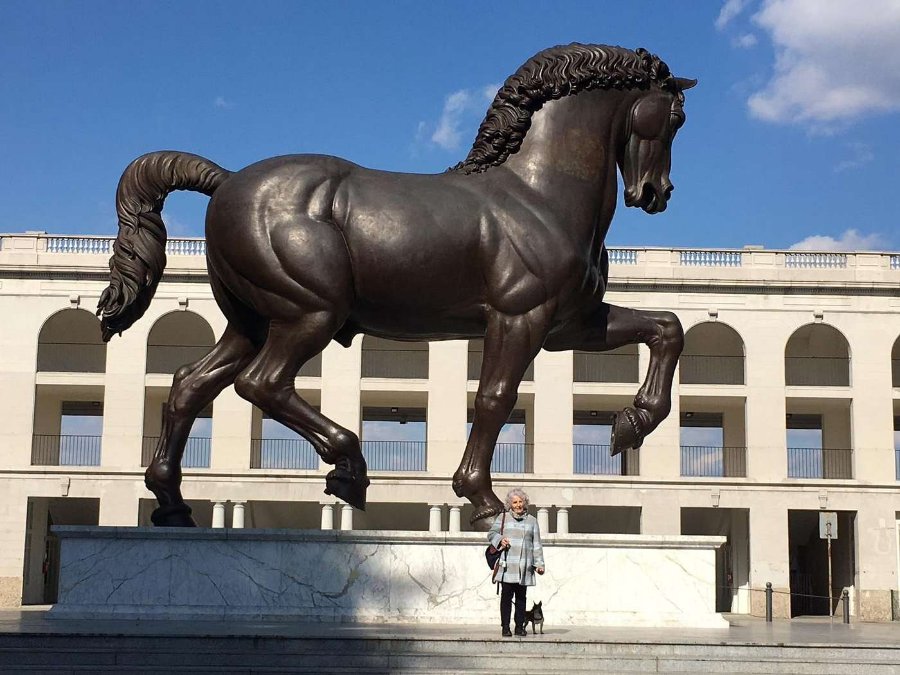
18. Leonardo’s Horse (Il Cavallo) — Milan, Italy
Sculptor: Nina Akamu, after Leonardo da Vinci · Date: 1999 · Material: Bronze · Height: 24 feet (7.3 m) · Location: Hippodrome of San Siro, Milan
In 1482 the Duke of Milan commissioned Leonardo da Vinci to cast the largest equestrian monument ever attempted. Leonardo spent years on the design and built a full-size clay model. In 1494 the bronze reserved for it was requisitioned to make cannon, and in 1499 invading French troops used the clay model for target practice. It was never cast.
Five centuries later, American sculptor Nina Akamu designed a 24-foot bronze horse based on Leonardo’s studies. Two full-size casts were made: the primary work was unveiled at Milan’s San Siro Hippodrome in 1999, and the second, The American Horse, stands at Frederik Meijer Gardens in Grand Rapids, Michigan.
It is the most interesting entry on this list precisely because it is not authentic. It is a completed intention — the closing of a commission that stayed open for 500 years.
Foundry note: Leonardo’s original casting plan was the real obstacle. He intended to pour the horse in a single piece, which at that scale would almost certainly have failed as the bronze cooled unevenly. Akamu’s version was cast in sections and assembled — the method Leonardo’s contemporaries used and that we still use today, because it is the method that actually works.
A towering bronze Leonardo’s horse statue displayed in a plaza, showcasing detailed artistry and grandeur.
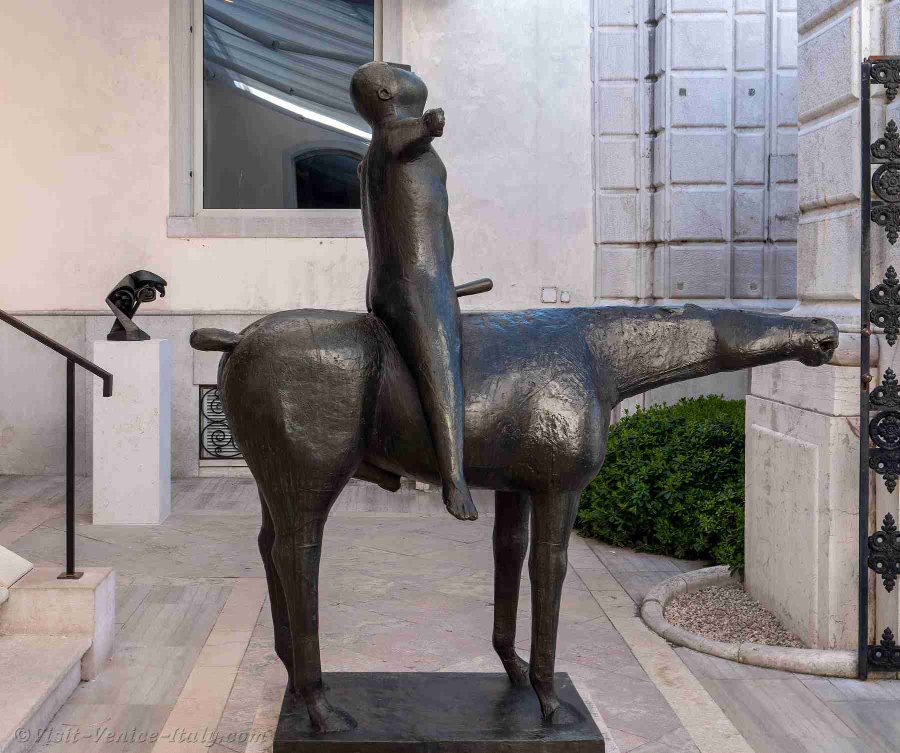
Marini’s L’angelo della città stands on the terrace of the Peggy Guggenheim Collection facing the Grand Canal, and it is the work that dragged the equestrian statue into the twentieth century.
The rider sits with arms flung wide and head tilted back, and both horse and man are stripped to rough, blocky essentials. Marini spent his career reworking the horse-and-rider motif, and across his output the rider progressively loses control — a deliberate inversion of a form that had celebrated mastery for two thousand years. After the Second World War, that inversion read as a statement about the collapse of the heroic ideal.
It is also, by some distance, the most-photographed sculpture in Venice after the Horses of Saint Mark.
A modern bronze Angel of the City statue displayed in an elegant courtyard.
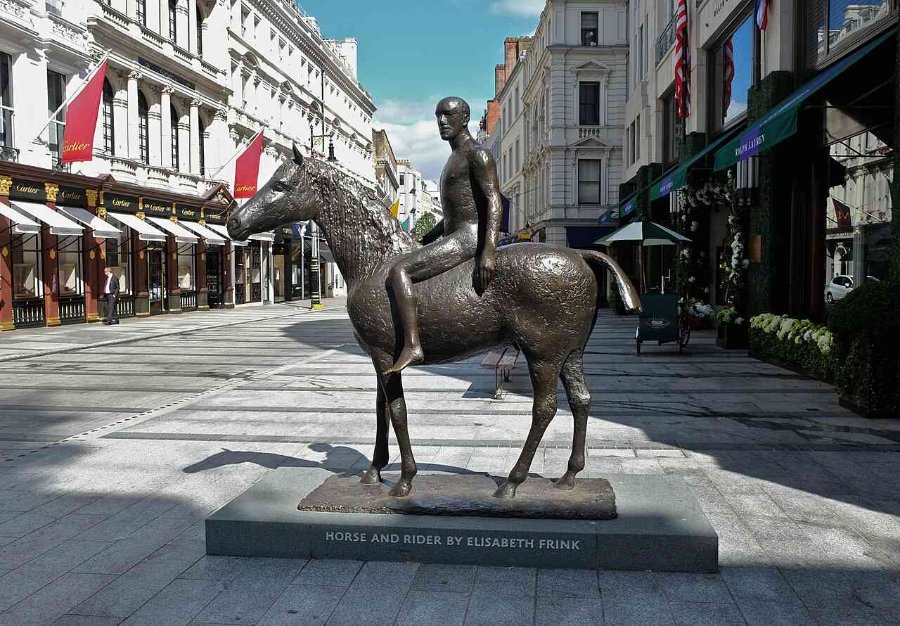
20. Horse and Rider — London, United Kingdom
Sculptor: Elisabeth Frink · Date: Cast 1975 · Material: Bronze · Height: 244 cm · Location: New Bond Street, Mayfair, London
Dame Elisabeth Frink modelled Horse and Rider in plaster at her Southwark studio and had it cast in bronze in 1975 at the Meridian Bronze Foundry in Peckham. It stood for decades at the corner of Dover Street and Piccadilly before being relocated to New Bond Street.
Frink described the work as “an ageless symbol of man and horse”, and that is exactly what it delivers. The rider is unarmoured, unnamed and undramatic. Horse and man simply stand together. After two thousand years of emperors and generals, Frink reduced the equestrian statue to the relationship underneath it — and this quiet piece is now among the most loved public sculptures in London.
Foundry note: Frink’s surfaces are deliberately left rough, carrying the marks of the plaster modelling straight through into the bronze. That is harder to achieve than a polished finish. Every tool mark has to survive moulding, casting and chasing intact, which means the chasers must know precisely which irregularities are the artist’s intent and which are casting flaws to be removed.
The bronze ‘Horse and Rider’ statue by Elisabeth Frink on display amidst luxury storefronts on a bustling city shopping street.
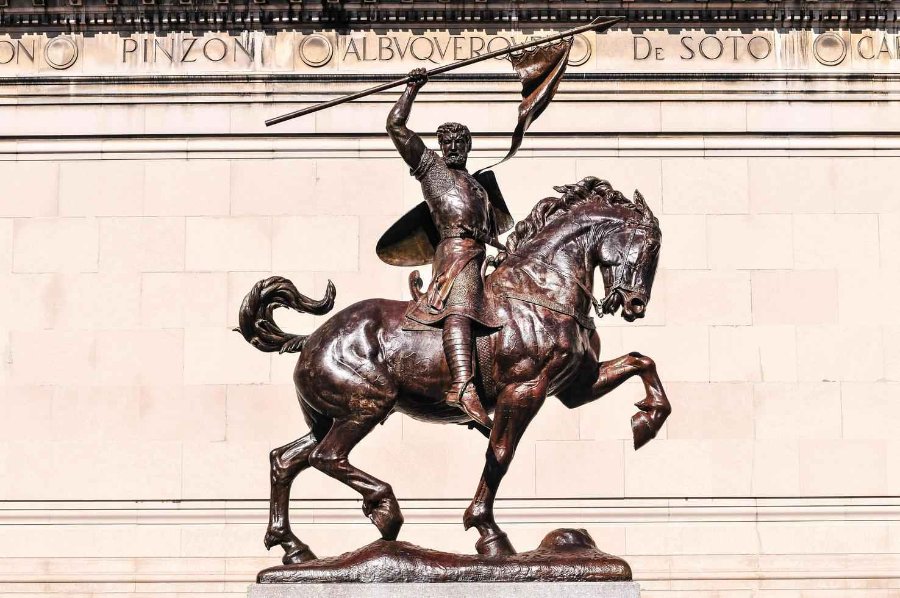
21. El Cid Campeador — New York City, USA
Sculptor: Anna Hyatt Huntington · Date: 1927 · Material: Bronze · Location: Hispanic Society of America, New York (further casts in Seville and San Diego)
Anna Hyatt Huntington was the foremost animal sculptor of her generation, and her monumental El Cid — the eleventh-century Castilian knight, lance raised — dominates the Hispanic Society’s terrace in Upper Manhattan. Further casts stand in Seville and in Balboa Park, San Diego.
She is worth ending on for two reasons. She built her reputation on rigorous equine anatomy at a time when few women were given monumental public commissions at all. And El Cid demonstrates something this whole list has been circling: a work does not need to be the tallest or the oldest to endure. It needs the anatomy to be right and the pose to be honest.
Foundry note: Multiple casts from one master model, installed on three sites across two continents, is a genuinely demanding form of quality control. Every cast has to match, and each site has its own foundation and climate conditions. It is the same discipline required whenever a client orders matching sculptures for several locations.
A striking bronze El Cid Campeador statue, symbolizing valor and strength, perfect for historical or landscape settings.
All 21 at a Glance
#
Statue
Location
Date
Material
Sculptor
Family
1
Marcus Aurelius
Rome, Italy
c. 175 AD
Gilded bronze
Unknown
Imperial
2
Gattamelata
Padua, Italy
1447–1453
Bronze
Donatello
Imperial
3
Bartolomeo Colleoni
Venice, Italy
1480–1488
Bronze
Verrocchio
Imperial
4
The Bronze Horseman
St Petersburg, Russia
1782
Bronze
Falconet
Imperial
5
Jeanne d’Arc
Paris, France
1874
Gilded bronze
Frémiet
Imperial
6
Horses of Saint Mark
Venice, Italy
2nd–4th c. AD
Gilded copper alloy
Unknown
Mythic
7
Quadriga, Brandenburg Gate
Berlin, Germany
1793
Hammered copper
Schadow
Mythic
8
Horse Tamers, Anichkov Bridge
St Petersburg, Russia
1841–1851
Bronze
Klodt
Mythic
9
The Kelpies
Falkirk, Scotland
2013
Steel
Andy Scott
Mythic
10
Mustangs of Las Colinas
Irving, Texas, USA
1984
Bronze
Robert Glen
Riderless
11
Still Water
London, UK
2011
Bronze
Fiddian-Green
Riderless
12
Flying Horse of Gansu
Lanzhou, China
c. 2nd c. AD
Bronze
Unknown
Riderless
13
Monekana
Washington DC, USA
2001
Cast bronze
Butterfield
Riderless
14
Man o’ War
Lexington, KY, USA
1948
Bronze
Haseltine
Champion
15
Secretariat
Lexington, KY, USA
20th c.
Bronze
Jim Reno
Champion
16
Seabiscuit
Arcadia, CA, USA
20th c.
Bronze
Tex Wheeler
Champion
17
Animals in War Memorial
London, UK
2004
Bronze (with stone wall)
Backhouse
Champion
18
Leonardo’s Horse
Milan, Italy
1999
Bronze
Nina Akamu
Modern
19
The Angel of the City
Venice, Italy
1948
Bronze
Marino Marini
Modern
20
Horse and Rider
London, UK
1975
Bronze
Elisabeth Frink
Modern
21
El Cid Campeador
New York, USA
1927
Bronze
Anna Hyatt Huntington
Modern
Nineteen of the 21 are cast in bronze or another copper alloy. That is not a selection bias — it reflects what the material can do. Bronze has dominated equine sculpture for two thousand years for a straightforward technical reason: it is the only material that will hold a horse’s weight on two legs, survive outdoors for centuries, and still record the surface detail of muscle and hide.
The two exceptions are instructive. The Brandenburg Quadriga is hammered copper sheet rather than cast alloy — a method chosen in 1793 to keep the weight low enough to sit on top of a gate. The Kelpies are fabricated steel, because at 30 metres casting is simply not available as an option. Both exceptions exist because of a constraint that bronze could not meet, which is the clearest possible demonstration of where the material’s limits actually lie.
Records and Superlatives
Tallest equestrian statue in the world: The Genghis Khan Equestrian Statue at Tsonjin Boldog, Mongolia — 40 metres of stainless steel, completed in 2008.
Tallest horse sculpture without a rider:The Kelpies in Falkirk, Scotland, at 30 metres per head.
Oldest surviving bronze equestrian statue: The Equestrian Statue of Marcus Aurelius, Rome, cast around 175 AD.
First life-size bronze equestrian statue since antiquity: Donatello’s Gattamelata, completed 1453.
Most travelled: The Horses of Saint Mark — Constantinople to Venice to Paris and back to Venice, across eight centuries.
Largest free-standing bronze sculpture in London:Still Water, at 10 metres.
What This Means for a Commission Today
Read across all twenty-one and a consistent pattern emerges. The works that survive and stay famous share three qualities: an honest anatomical foundation, a pose the material can genuinely support, and a finish appropriate to where the piece actually stands.
The failures of history — the pieces melted, cracked or quietly removed — usually failed on the second point. A pose was chosen for drama without the internal structure to carry it.
This is the same conversation we have with clients now. When a landscape architect asks for a rearing life-size bronze stallion for an exposed hilltop entrance, the first questions are about the site, not the sculpture: what are the wind conditions, what foundation depth is available, and how will the piece be craned into position. Donatello’s orb under the raised hoof and a modern hidden steel core are answers to the identical problem, five hundred and seventy years apart.
We have been casting horses in bronze since 1983 — life-size and heroic-scale, standing, walking, trotting and rearing, using the same sectional lost-wax method that produced most of the statues in this guide. Pieces leave our workshop in export-grade wooden crates with installation guidance for the receiving site.
If a particular statue in this guide is close to what you have in mind, that is a useful place to start a conversation. Tell us which one and where it would stand, and our design team can advise on what the pose requires structurally at your site and scale.
Frequently Asked Questions
What is the most famous horse statue in the world? The Equestrian Statue of Marcus Aurelius in Rome is generally considered the most important, as the only intact bronze equestrian statue surviving from ancient Rome and the model for the entire Western tradition. By visitor numbers and recognition, the Horses of Saint Mark in Venice and The Kelpies in Scotland are also strong candidates.
What is the oldest horse statue still standing? Among large bronzes, the Marcus Aurelius, cast around 175 AD. The Flying Horse of Gansu dates from roughly the same period but is a small tomb object rather than a public monument.
What is the tallest equestrian statue in the world? The Genghis Khan Equestrian Statue in Mongolia, at 40 metres of stainless steel, completed in 2008.
Do a horse’s raised hooves mean the rider died in battle? No. There is no such code. The legend originated with a partial coincidence among the Gettysburg battlefield monuments and does not hold anywhere else. Pose is determined by structural load, casting cost and site conditions.
What is the difference between a horse statue and an equestrian statue? An equestrian statue specifically depicts a horse with a rider. A horse statue is the broader category and includes riderless works such as Still Water and the Mustangs of Las Colinas.
Which material lasts longest outdoors? Hot-cast bronze, by a wide margin, because it forms a self-protecting patina rather than corroding through. Stainless steel is used above roughly 15 metres where bronze becomes impractical as a structural material.
Can a horse statue be made in a specific pose? Yes. Standing, walking, trotting and rearing are all achievable at life size and above. The pose determines the internal armature, the number of cast sections and the foundation requirement, so it is worth settling early in the design process rather than late.
Senior Sales Director at YouFine, specializing in premium bronze sculptures for global clients.
With years of hands-on experience in sculpture consulting, production coordination, and international project communication, she has developed deep expertise across a wide range of artistic categories—especially bronze horse statues.
Beyond work, Jane is a true art lover who enjoys life, beauty, and creative expression. Among all sculpture themes, she has a special passion for bronze horses—their strength, elegance, and spirit continue to inspire her every day.