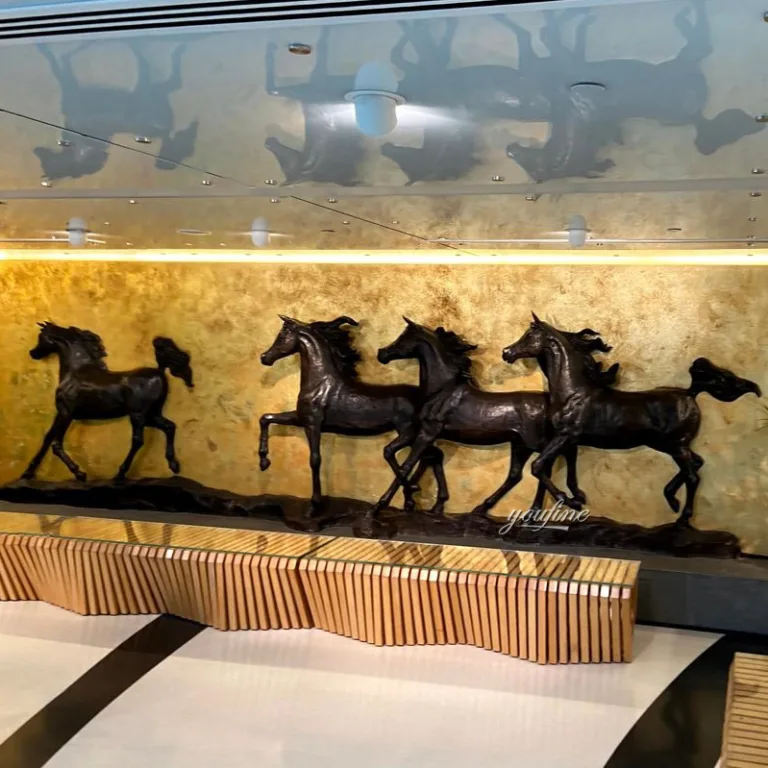

The bronze patina color chart you approve at the workshop is not the color you will be looking at in ten years. That is not a defect, and it is not something the foundry got wrong. It is what bronze does.
Patina is a reaction on the surface of the metal rather than a layer sitting on top of it, which means it does not stop when the crate is closed. It keeps going — slowly, and in a direction set by the finish you chose and the climate the piece lives in.
Here is where each family of finishes ends up at year one, year five and year twenty, and what your local weather does to that timeline.
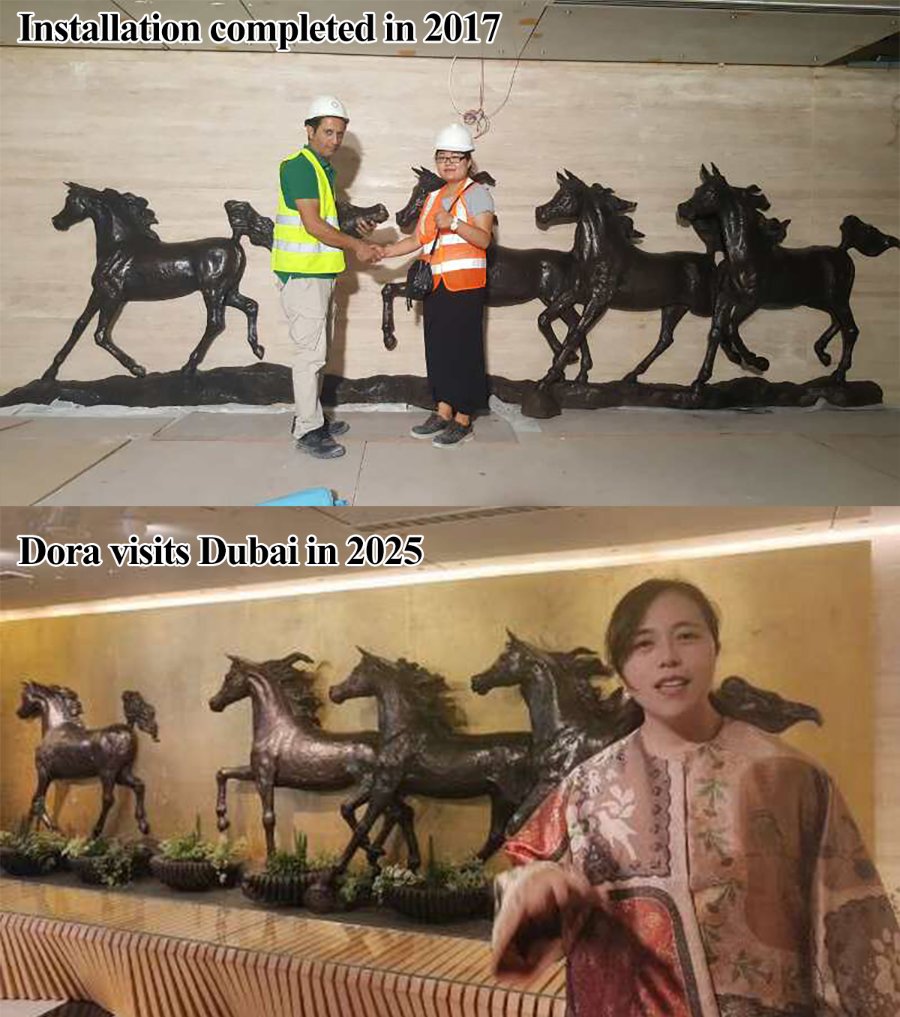
Why the Color You Approve Is Not the Color You Keep
Most owners expect a finish to behave like paint: the color is decided, then it stays. Bronze works the other way.
Because the color is produced by a chemical reaction with the metal itself rather than applied as a coating, the surface you see at delivery is a point on a curve, not a final state. Our how a bronze horse statue is made page covers how that reaction is applied in the workshop. What it does not cover is what the reaction does next, which is the subject here.
So the useful question is not which finish looks best in a photograph. It is which direction that finish travels, and how fast.
Across everything we have cast since 1983, the finishes sort into three behaviours:
- They darken and settle. The warm browns deepen slightly, then hold. This is the most stable family outdoors.
- They hold, but only under protection. The dark blacks are sensitive to ultraviolet light; they keep their color as long as the protective layer over them is maintained.
- They keep moving. The green finishes continue toward verdigris. That is where they are supposed to end up.
Nothing in that list is a flaw. It is a description of three different destinations.
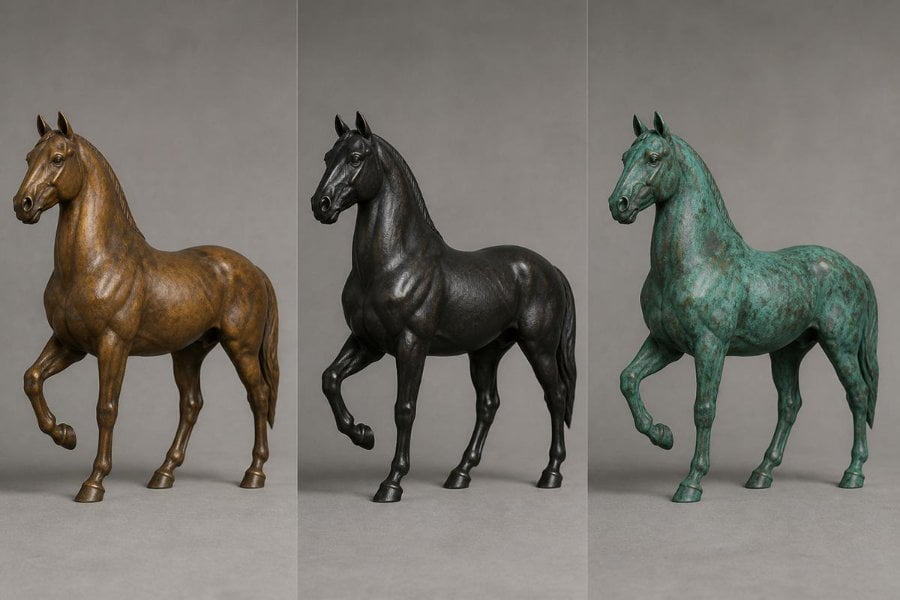
The Bronze Patina Color Chart: Where Each Finish Ends Up
Read this as a bronze patina color chart measured in years rather than in swatches.
| Finish family | Year 1 | Year 5 | Year 20 | Climate sensitivity |
|---|---|---|---|---|
| Warm browns | as approved | settles and deepens slightly | stable | low — the most stable family outdoors |
| Dark blacks | as approved | holds while the protective layer is kept up | the family where change is most visible | high — sensitive to ultraviolet |
| Verdigris greens | as approved | still moving | near its final state | highest — the most demanding to maintain |
| Gilt and bespoke finishes | as approved | depends on the topcoat | depends on the topcoat | judged case by case |
Two columns in that table need explaining.
Year 1 is the only column you can judge in a photograph. Everything to its right depends on where the piece lives.
The right-hand column is not a quality ranking. A high-sensitivity finish is not a worse finish. A verdigris green that keeps moving is doing exactly what it was ordered to do. A dark black that keeps moving is the one to watch, because black is a destination rather than a direction.
The behaviour labels come from our own production records: the three families are the ones we have catalogued across more than 200 documented color profiles since 1983, and the same records are where the labels come from — the warm browns are the most stable outdoors, the dark blacks are the ones ultraviolet light reaches, and the greens ask the most of an owner.
If you want to see what the individual finishes look like, rather than how they behave, the bronze horse patina options on our custom service page show each one.
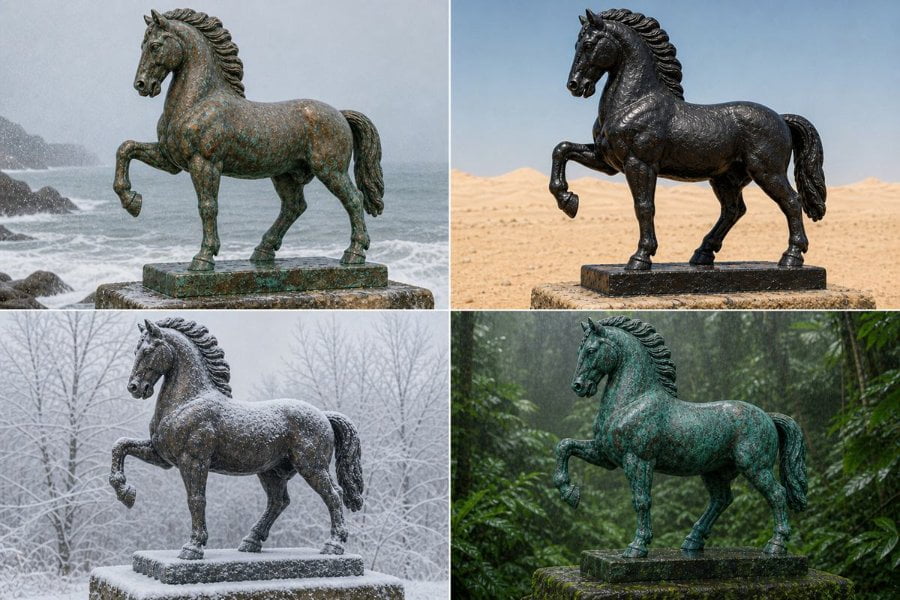
Why the Same Finish Ages Differently on a Coast, in a Desert and in a Hard-Winter Climate
The same finish, cast from the same mold, will not look the same in two places after five years. It has nothing to do with the casting.
Four climate lines cover where almost all of our clients’ pieces stand:
- Coastal salt air. Salt accelerates oxidation on any metal surface. The finish moves faster, and the protective layer needs renewing more often.
- Desert and high-ultraviolet. The risk here is not water; it is light. Ultraviolet is what the dark finishes are sensitive to, so a black horse in strong sun asks more attention than the same horse in shade.
- Hard-winter and freeze-thaw. The surface is repeatedly wet and then frozen. Water sitting in any recess works on the finish, and on the metal, from the outside in.
- Hot and humid. Moisture and ultraviolet arrive together, which is the combination that shortens maintenance intervals fastest.
We publish a climate-based care schedule — how often to renew the protective wax layer — on our how a bronze horse statue is made page. What that schedule does not tell you is the half this article is about: under the same schedule, which way the color itself moves.
Both halves matter, and they are different questions. If you tell us where the horse is going, we send the maintenance guidance for that destination — that is part of every commission. General weather and finish questions are collected on our weather and maintenance guidance page.
Is Green Patina a Defect?
This is the question we are asked most often about finish, and it has a precise answer: it depends on which finish you ordered.
If you commissioned a verdigris green, green is the destination. It is the finish doing what it was chosen for, and the movement is not a fault to be corrected.
If you commissioned a dark brown or a black, a green cast is a departure from the intended direction. It usually means water has been sitting on the surface, or that the protective layer has gone past its interval. It is a maintenance signal rather than damage.
So the decision splits four ways:
- Do nothing. Correct when green is the ordered finish and the piece is otherwise sound. Cleaning a verdigris finish pulls it back toward raw metal.
- Clean the surface. Correct for salt and atmospheric deposits sitting on a dark finish. This is routine upkeep, not restoration.
- Renew the protective layer. Correct when the color has begun to drift on a finish that was supposed to hold. This is the most common fix and the least involved.
- Re-patina. Correct when the drift is advanced, or when a repair has exposed bare metal. Bringing a bronze back to its intended finish is a scheduled event, not an emergency.
Nothing in that list is damage. Three of the four are ordinary upkeep.
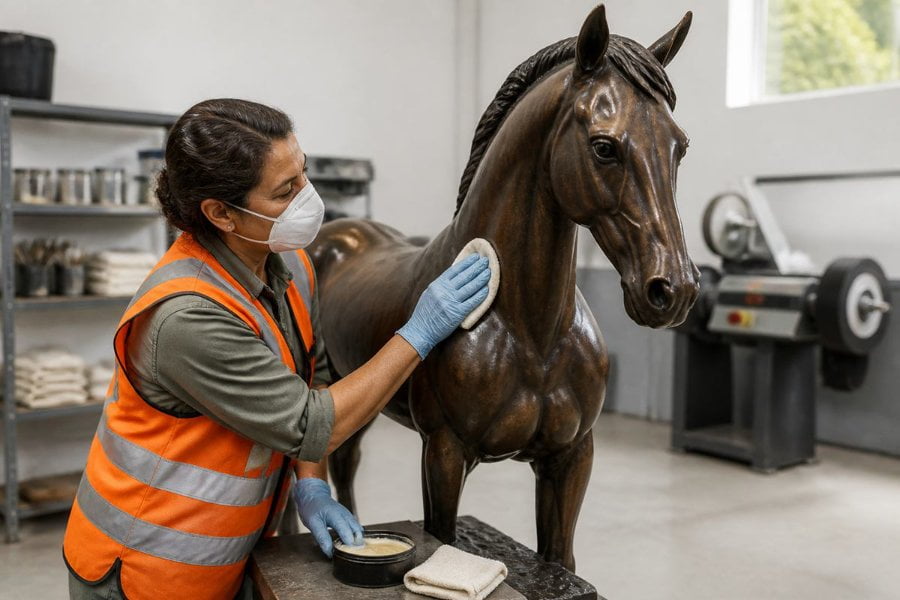
What to Check Before You Approve a Finish
A finish is approved at a moment when almost nothing about its future is visible. These five checks are worth more than any swatch.
Ask for the family, not just the color. Two finishes that look similar at approval can belong to different families, and the family is what behaves differently. The family tells you the destination.
Judge the sample in daylight. A finish approved under warm workshop lighting and then stood outdoors will read differently. Ask to see a photograph taken outside, in the middle of the day, without a filter.
Ask what year five looks like, not what today looks like. A foundry that has delivered and revisited its work can answer this. One that only sells cannot.
Ask which climate line the piece is going into. Coastal, desert, hard-winter or humid changes both the maintenance interval and the direction of travel.
Ask what happens when the color moves. Not whether it moves — it will. What the correct action is when it does.
If you are choosing now, the custom bronze horse statue page shows the finishes we produce and the process behind them.
Why Bronze Horse Foundry
Bronze Horse Sculpture Foundry has been casting bronze in Quyang, Hebei — China’s historic sculpture region — since 1983.
- More than 5,000 bronze horse sculptures completed, with records kept on every one.
- More than 200 documented patina color profiles, and the ability to match a reference photograph.
- 500+ production-ready design templates, plus fully custom work from clay modeling.
- Cast in silica sol with an internal steel armature, at life size and above.
- Delivered to more than 30 countries.
- Climate-specific maintenance guidance with every piece, for every destination.
The finish is the part of a commission worth discussing earliest, because it is the part that keeps changing after everyone else has gone home. When you are ready to talk about poses and scale, our rearing bronze horse sculptures, standing bronze horse statues and racing horse statues show the three most common directions for outdoor work.
Bronze Patina Colors: Five Questions
Does bronze patina change color outdoors? Yes. Patina is a reaction on the metal surface rather than a coating on top of it, so it continues after delivery. How far it moves, and how quickly, depends on the finish family and the climate the piece stands in.
Why does my bronze horse turn green? Bronze contains copper, and copper compounds trend toward green. Whether that is correct depends on the finish you ordered. Green is the destination for a verdigris finish, and a departure for a dark one.
Can patina be removed or reset? It can be adjusted. Cleaning shifts a surface back toward raw metal, renewing the protective layer slows a drift, and re-patina restores an intended finish. Which of those is right depends on what you ordered in the first place.
Which patina color is most stable outdoors? The warm browns. The dark blacks hold as long as the protective layer over them is maintained, and the greens are the most demanding, because they are still in motion.
How often does bronze patina need maintenance? Climate matters more than the finish here. Coastal and humid locations ask for more frequent renewals than temperate or dry ones. We issue a schedule for the destination with every commission.
Conclusion
A finish is not a decision you make once and then check off. It is the beginning of a slow, predictable change, and the value of knowing the direction is that you can plan around it — what to expect in year five, what to do when the surface drifts, and whether the green appearing on a bronze horse in year eight is a problem or the whole idea.
If you have a finish in mind, a climate and a site, send them to us. We will tell you what that color does where you are.