
By YouFine Sculpture | Est. 1983
Let’s start with the thing nobody says out loud.
When you see an equestrian statue — a rider on horseback, cast in bronze, mounted on a stone plinth in some city square or estate entrance — your first thought is rarely “I wonder what the horse’s legs mean.” Your first thought is something more like: who decided this person deserved one of these?
That’s the right question. And the answer tells you almost everything about what equestrian statues actually mean.
What Is an Equestrian Statue?
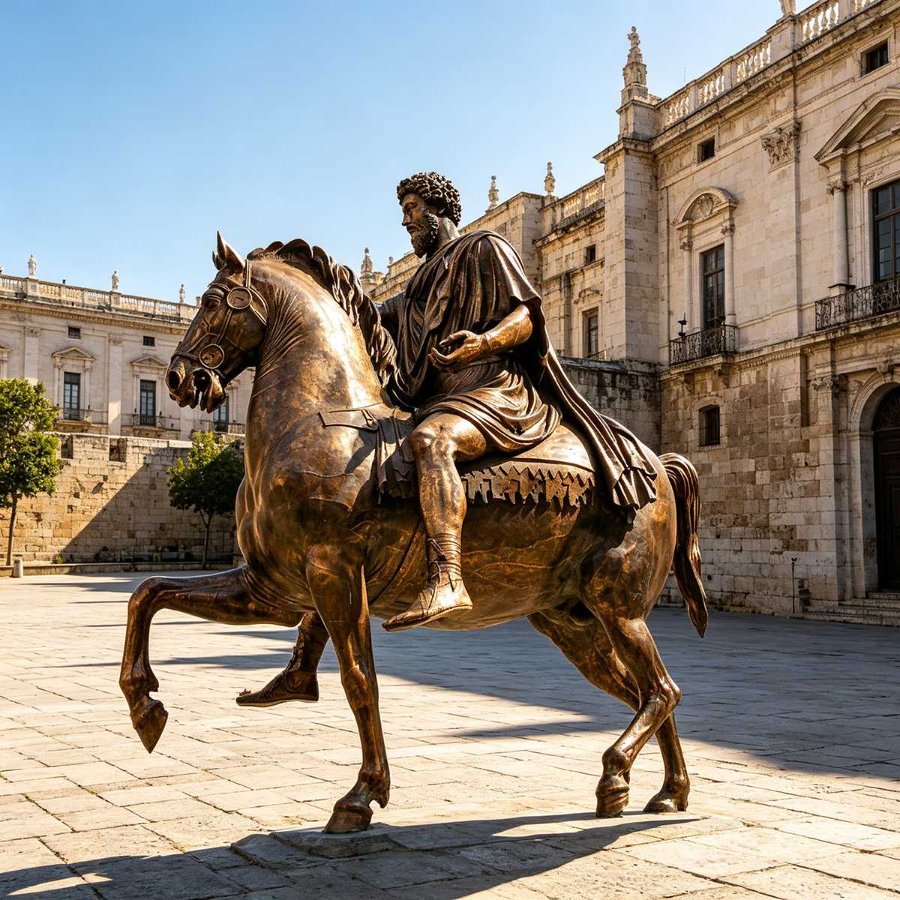
An equestrian statue is a sculpture depicting a person on horseback. That’s the simple definition. But the fuller one is this: it is one of the most expensive, most labor-intensive, most politically loaded forms of public art that human civilization has ever invented — and it has been produced almost continuously for over two thousand years.
The word comes from the Latin equester, meaning “of a horseman.” Roman generals had them. Renaissance condottieri had them. Emperors, kings, revolutionary heroes, and war commanders had them. Today, private collectors, equestrian estate owners, and landmark hotels have them.
The form has survived because the message it sends is durable. But that message is more specific — and more interesting — than most people realize.
What Does an Equestrian Statue Symbolize?
Here is the conventional answer: power, victory, authority, leadership. A figure on horseback is elevated — literally above eye level — and the horse amplifies everything about them. Size, momentum, presence.
That’s all true. But it’s also a bit like saying a Rolls-Royce symbolizes “success.” Technically accurate. Doesn’t quite get at the thing.
The more precise answer is this: an equestrian statue has always been a commissioned argument.
Someone — a senate, a dynasty, a patron, a government — looked at a particular person and decided: this person, and what they represent, should be permanently installed in the visual memory of this place. The statue is the argument. The rider is the subject. But the statue itself is the statement made by whoever paid for it.
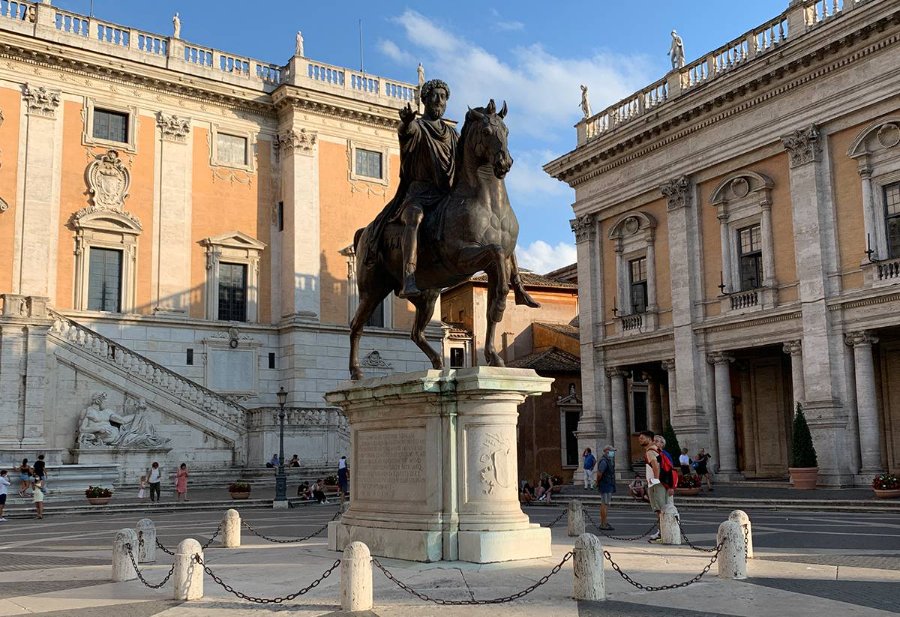
Marcus Aurelius on horseback in Rome was the Senate’s argument that this emperor was worth remembering. Napoleon on horseback at St. Bernard — painted by Jacques-Louis David, famously at Napoleon’s own request — was Napoleon’s argument about how Napoleon should be understood. The famous equestrian statue of El Cid in Seville is 20th-century Spain’s argument about national identity and medieval heroism.
Every equestrian statue is a message sent by someone, about someone, to everyone who walks past it. The rider is the subject. The statue is the medium. The real author is whoever commissioned it.
This is what separates equestrian statues from most other art forms. A painting hangs in a gallery for those who choose to enter. An equestrian statue stands in a public square, an estate entrance, or a lobby — and it delivers its message to everyone whether they asked for it or not.
Does the Horse’s Pose Have a Meaning?
Yes — though not in the way most people think.
The horse’s pose shapes the emotional register of a statue. A rearing horse creates urgency and drama. A horse in mid-gallop communicates momentum and forward force. A horse standing still, head raised and alert, reads as composed authority. These are real effects, and any sculptor working at a serious level is making deliberate decisions about them.
What the pose doesn’t do is encode a biography.
Is the Horse-Leg Rule Really True?
Almost certainly not — and we’ve written about this in detail before.
The short version: the popular legend holds that at Civil War battlefields, the number of raised hooves tells you how the rider died in combat. Both front legs raised: killed in battle. One front leg raised: wounded. All four on the ground: died of natural causes.
Researchers have actually checked this against the statues at Gettysburg1. The pattern doesn’t hold. Historians have found no evidence that any sculptor or commissioner ever intended such a system. It’s a folk story — appealingly tidy, widely shared, and demonstrably incorrect.
But here’s the part worth keeping: people want the rule to be true because they correctly sense that a horse’s posture does carry meaning. The instinct isn’t wrong. Just the specific code.
The real meaning of a horse’s pose is atmospheric, not biographical. It shapes how a space feels — not what a rider’s death certificate says.
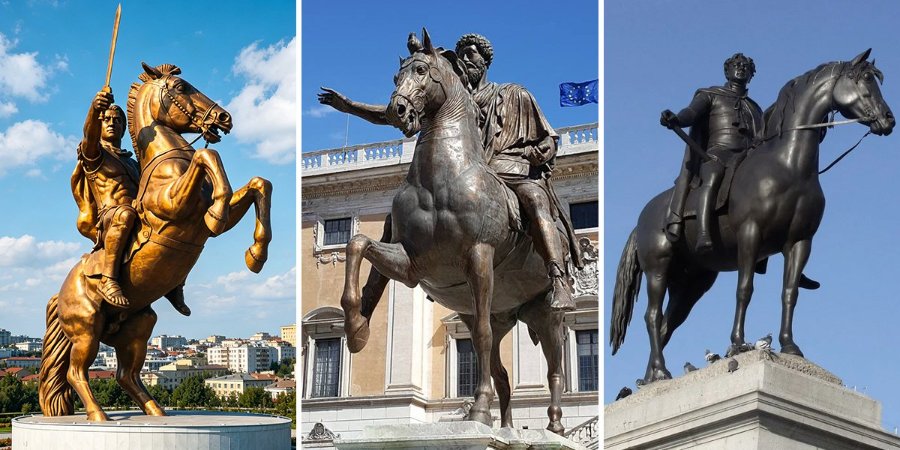
Famous Equestrian Statues Around the World
For a longer list, see our full guide: 21 Famous Horse Statues Around the World
A few worth knowing — not as a checklist, but because each one illustrates something different about how the form works:
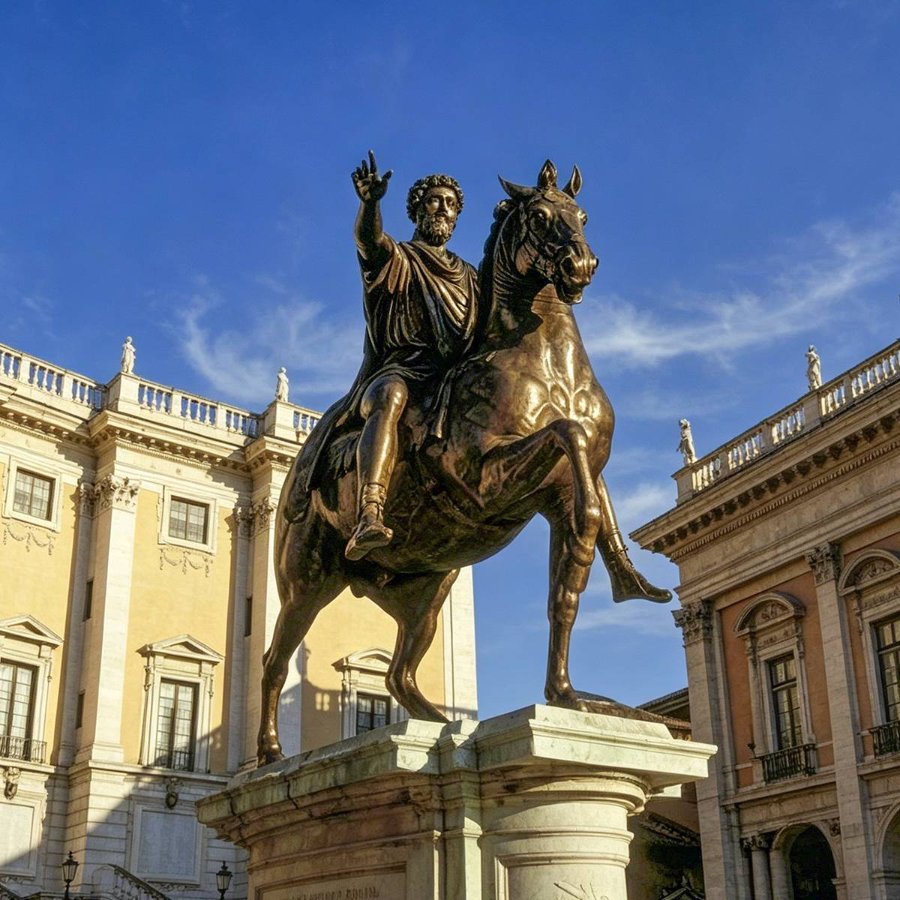
Marcus Aurelius2, Rome (c. 175 AD)
The oldest surviving large equestrian bronze in Western history. The horse lifts one foreleg in a gesture of restraint — or greeting, depending on interpretation. The rider’s right hand extends palm-down, the traditional Roman gesture of adlocutio: addressing troops, or granting clemency. For centuries, visitors have tried to explain the raised hoof. The more interesting thing to notice is the hand.
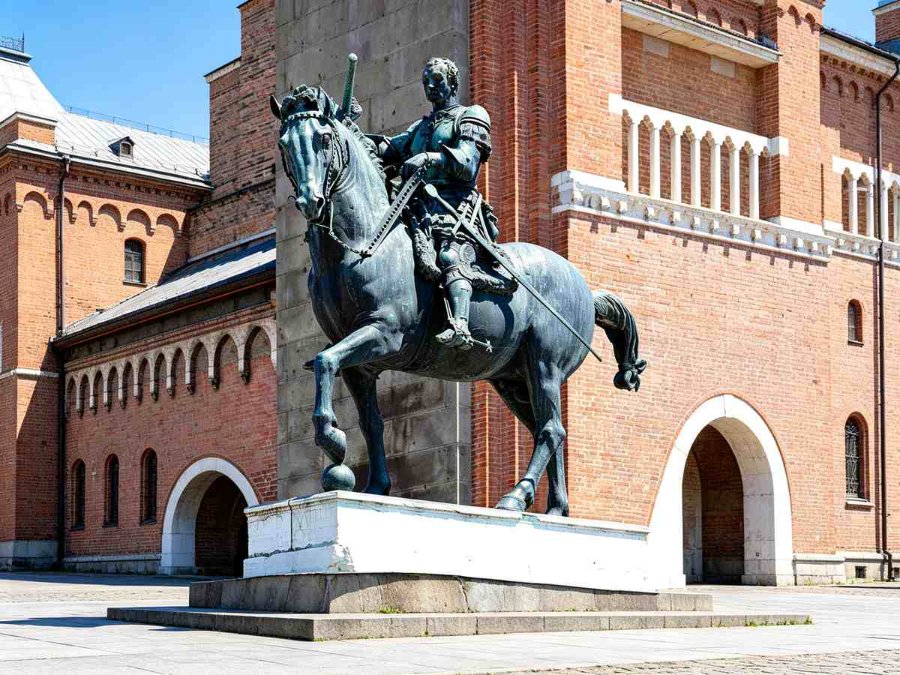
Gattamelata, Padua3, Italy (1453)
Donatello’s condottiere (mercenary general) Erasmo da Narni, cast at the request of the Republic of Venice after his death. It was the first large equestrian bronze cast in Italy since antiquity — a deliberate revival of a form associated with Roman imperial power. The argument: this city, and this general, are the rightful heirs of Rome.
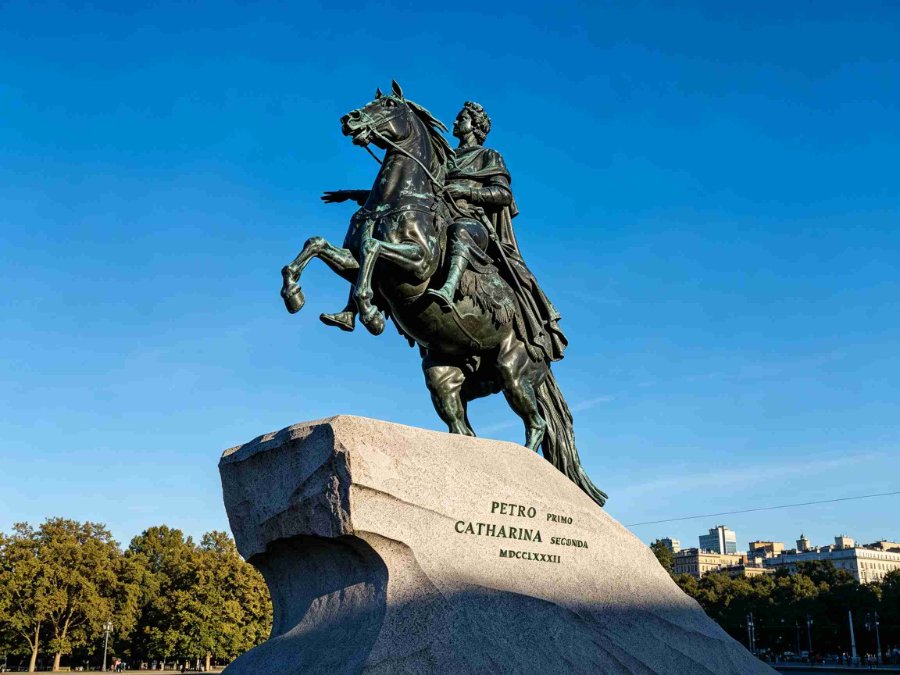
Peter the Great, St. Petersburg (1782)
Known as the Bronze Horseman. The rear legs of the horse rest on a serpent, which Catherine the Great used as a structural support and symbol simultaneously: the serpent representing enemies of Russia, crushed under Peter’s horse. Commissioned by Catherine partly to legitimize her own reign by association with Peter’s legacy. Classic equestrian statue logic: the commissioner’s argument, made through someone else’s likeness.
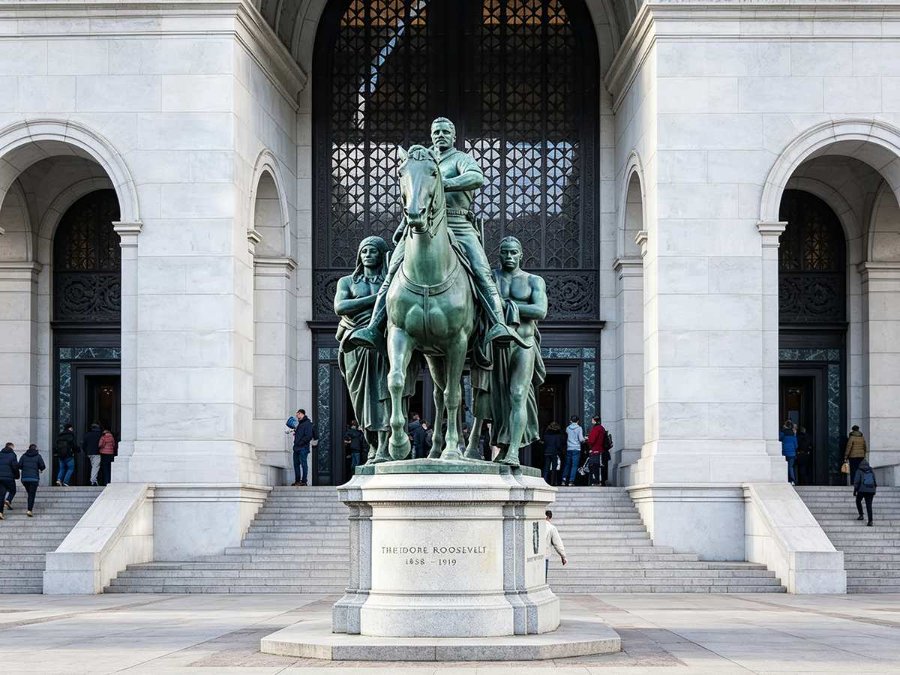
4Theodore Roosevelt, New York (1940, relocated 2022)
For 80 years this stood outside the American Museum of Natural History. Roosevelt on horseback, flanked on foot by figures representing Africa and the Americas. In 2022 the museum requested its relocation, and the City of New York agreed. Whatever the original intent, the composition had come to represent something its commissioners probably didn’t consciously intend — and the argument it was making was no longer acceptable. It now stands in Medora, North Dakota, where Roosevelt’s personal western history gives it a different context.
How to Commission a Custom Equestrian Statue
Before anyone talks about size, material, or pose — the first question is: what argument do you want this statue to make?
That’s not a vague question. When clients come to us at YouFine, the most useful brief is never a dimension spec. It’s a sentence like:
“I want anyone who arrives here to understand what this place stands for.”
That one sentence tells us the pose, the scale, the base, the patina. Everything else follows from it.
A few practical notes:
- Scale: With a rider, a life-size equestrian statue runs 8–10 feet tall before the base. First-time clients almost always underestimate what the space actually needs. Design around the primary viewing distance, not the footprint.
- Material: Bronze is the standard because it’s the only material that gets better with age — the patina deepens, shifts, earns its place over decades. Nothing else does this.
- The rider: This is what separates an equestrian commission from a horse-only piece. Whether you’re reproducing a historical figure, commissioning a contemporary likeness, or working with an idealized form, the likeness process adds lead time. Budget for it.
- Timeline: Life-size, start to delivery: 16–24 weeks. You’ll approve the clay model before we proceed to bronze — that’s the moment changes are easy. After casting, they’re not.
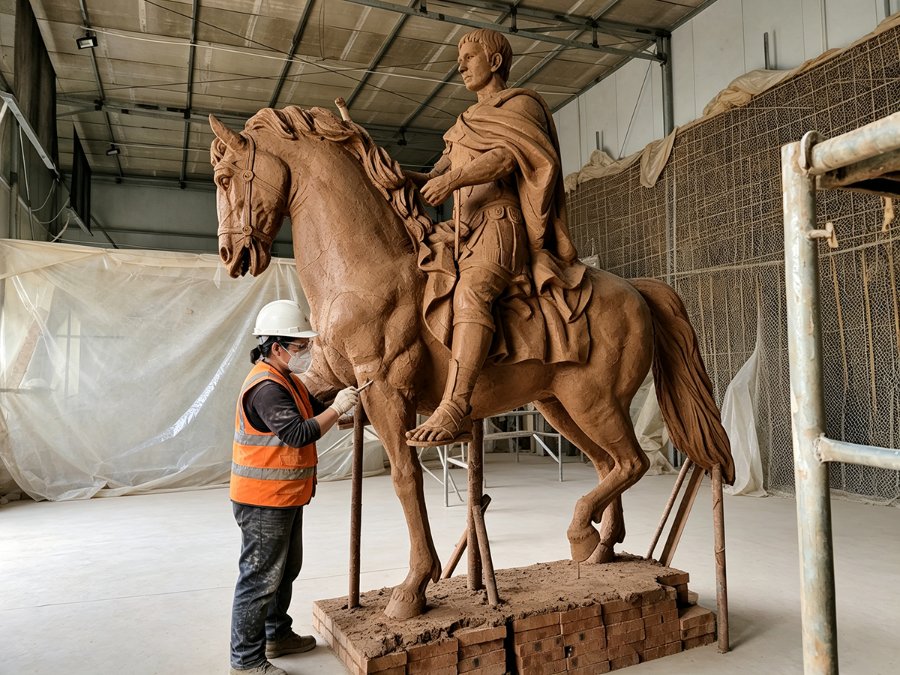
If you’re considering a commission, start here. Tell us the setting and — most importantly — what you want it to say.
FAQ
What’s the difference between an equestrian statue and a horse statue?
An equestrian statue includes a rider. A horse statue depicts the animal alone. The equestrian form adds a second layer of meaning — a specific human figure whose identity, era, and context shape how the whole piece is read. A horse alone carries symbolic meaning (power, freedom, momentum). An equestrian statue carries all of that plus a biographical and political argument about the rider.
Why are so many equestrian statues being removed or relocated?
Because they have always been arguments, not decorations. When public opinion shifts on whether a particular historical figure deserves permanent, elevated commemoration in a shared space, the statue becomes contested in a way that a neutral monument wouldn’t be. The removals of recent years reflect changing consensus about what certain historical figures represented — which is exactly the mechanism the statues were designed to operate through. The argument was made. Now it’s being answered.
Can I commission an equestrian statue of a living person or myself?
Yes. Private commissions of contemporary figures — including equestrian portraits of the client — are among the most personally meaningful projects we produce. They require good photographic reference for the likeness, clear decisions about costume and pose, and realistic expectations about lead time. Many clients commission equestrian portraits of deceased family members using historical photographs. We’ve done both.
How much does a custom equestrian statue cost?
Equestrian statues are significantly more complex than horse-only commissions — the rider adds a full additional sculptural figure, likeness work, and compositional decisions that affect structural engineering. Life-size commissions typically start at a higher price point than a comparable horse alone. The most accurate way to get pricing is to share your project scope with us directly — setting, approximate size, whether a specific likeness is required, and your timeline. We’ll come back with a detailed proposal.
What base or pedestal does an equestrian statue need?
Most equestrian statues are mounted on raised plinths — this is partly structural (the base anchors the sculpture safely), partly visual (elevation is part of what makes the form legible at distance), and partly historical (raised placement has always been part of the statement). We work with clients and their architects or landscape designers on base specifications, and can advise on appropriate materials, heights, and anchoring methods for the installation environment.
How long do bronze equestrian statues last outdoors?
Bronze is among the most durable materials available for outdoor sculpture. Well-cast bronze equestrian statues last centuries — the Marcus Aurelius is approaching two thousand years. The main maintenance requirement is occasional wax coating (every 2–3 years in harsh climates, less frequently in mild ones) to manage the rate and evenness of patination. No painting, recoating, or structural maintenance is typically required.
- https://www.politifact.com/factchecks/2018/oct/26/blog-posting/no-equestrian-statues-dont-have-secret-code-hooves/ ↩︎
- https://en.wikipedia.org/wiki/Equestrian_statue_of_Marcus_Aurelius ↩︎
- https://en.wikipedia.org/wiki/Gattamelata ↩︎
- https://en.wikipedia.org/wiki/Equestrian_Statue_of_Theodore_Roosevelt_(New_York_City) ↩︎