
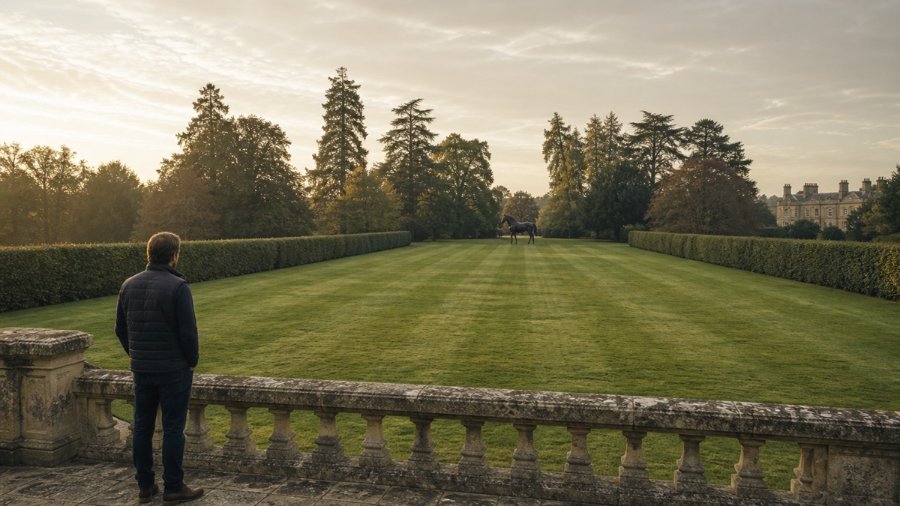
A bronze horse statue settles into a garden when its scale and pose match the space. Get those two decisions right, in that order, and it looks as though it had always been there.
We have cast bronze in Quyang, Hebei — a city the Chinese government recognizes as the nation’s sculpture production hub — for over forty years, and one pattern holds: buyers of a bronze horse for garden settings choose the pose first and the size last. This guide walks both decisions in sequence, then hands you the questions worth asking any foundry.
Start With the Site, Not the Statue
Four Things to Measure Before You Look at a Single Model
The sightline. Measure from where people actually linger — a terrace, a main path — to where the horse will stand, not the size of the lawn.
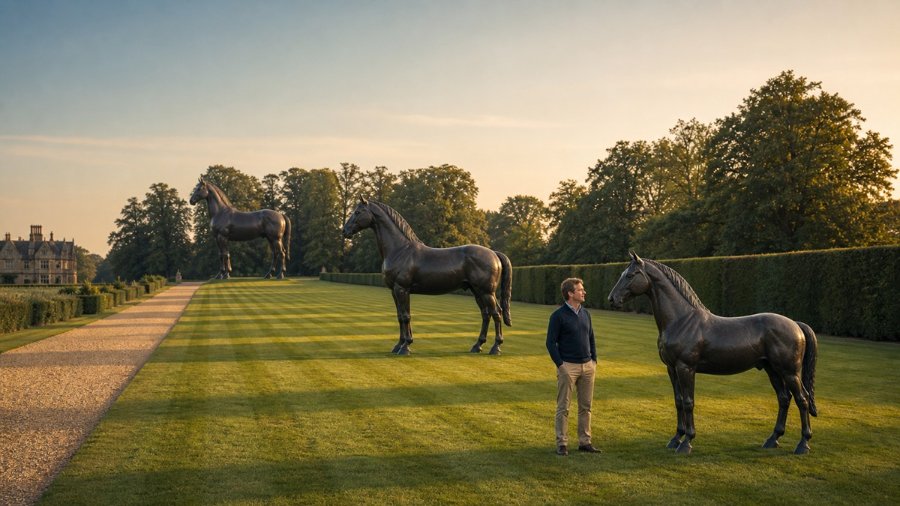
The eye-level relationship. Up close a horse is read through head, mane, and shoulder. At long range only the silhouette survives, so a large bronze horse statue reads across a garden where a smaller one becomes furniture.
Mature planting height. Measure the space as it will look in five years. A knee-high hedge becomes a wall that swallows anything shorter.
Wind and ground. A bronze horse is a sail. Coastal and elevated sites load it far more than a sheltered courtyard, and the ground decides whether a concrete foundation is possible.
Why the Plinth Counts as Part of the Sculpture
The plinth is part of the silhouette, not an accessory added later. A 60 cm plinth lifts a life size bronze horse clear of planting but raises its wind profile and can make it feel displayed rather than placed; a low stone base keeps it in the landscape.
Sizes That Work in a Garden, From Life Size Up
Life size. The baseline for a focal point: a lawn center, the end of a path. Wrong when the main sightline runs from a house thirty meters away, where the modeling is unreadable.
1.25 to 1.5 times life size. For drive circles, entrance forecourts, and estate axes, where the figure must be seen at a distance and at speed — and too large for a small enclosed garden.
Monumental, or multi-horse groups. Landmark territory. Spacing is part of the design: horses set too close read as one mass, too far apart lose their relationship.
Then Choose the Pose: What Your Garden Is Already Saying
Pose is where most equestrian bronze sculpture buyers start, and it is the decision a garden has usually already made.
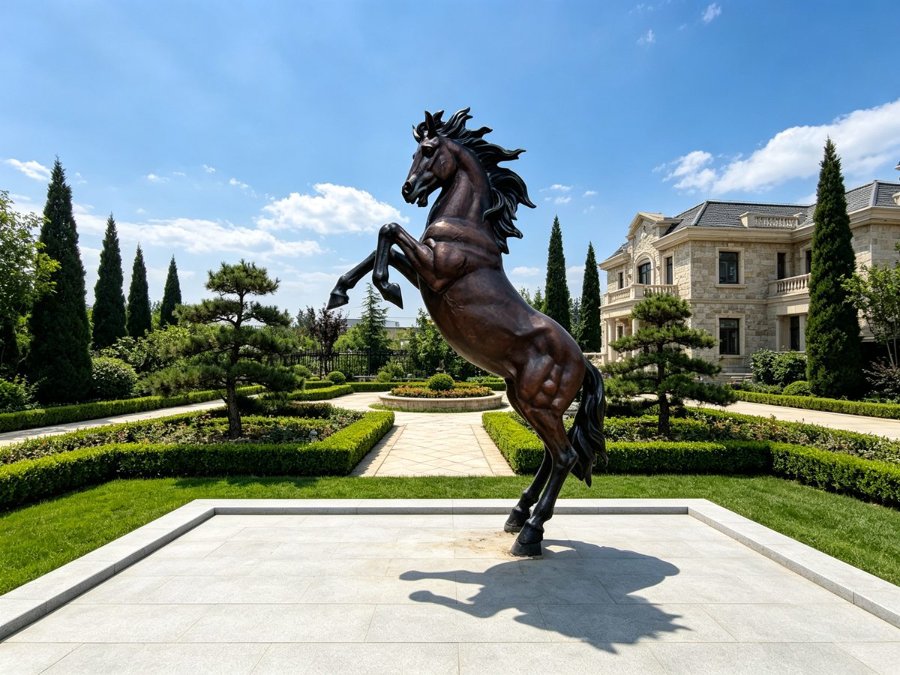
Rearing: Entrances, Gate Piers, and the Drama of Arrival
A bronze rearing horse carries momentum and ceremony, which is why it belongs at an entrance rather than deep in a border. Give it open foreground; against a wall, the gesture has nowhere to go.
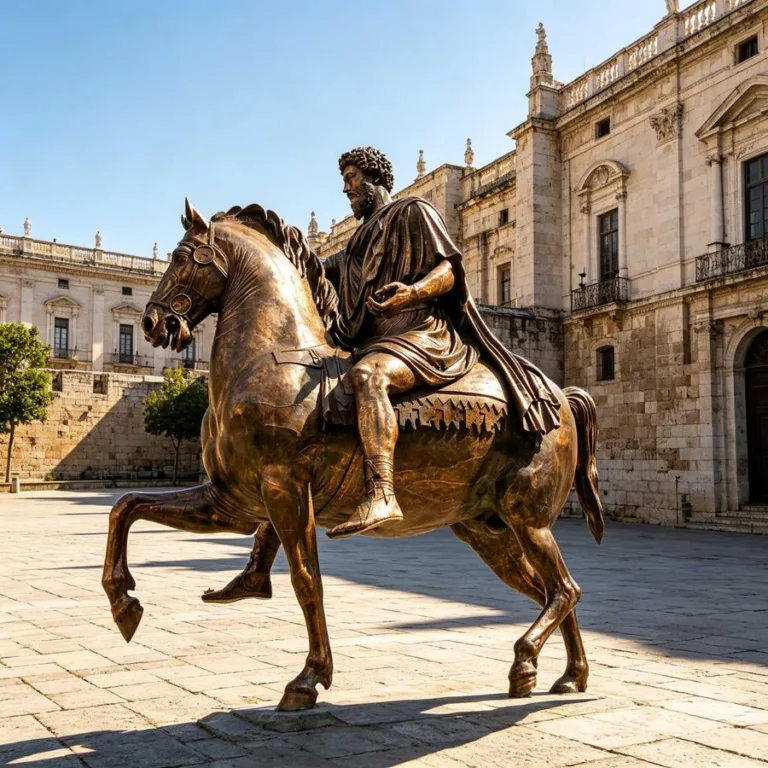
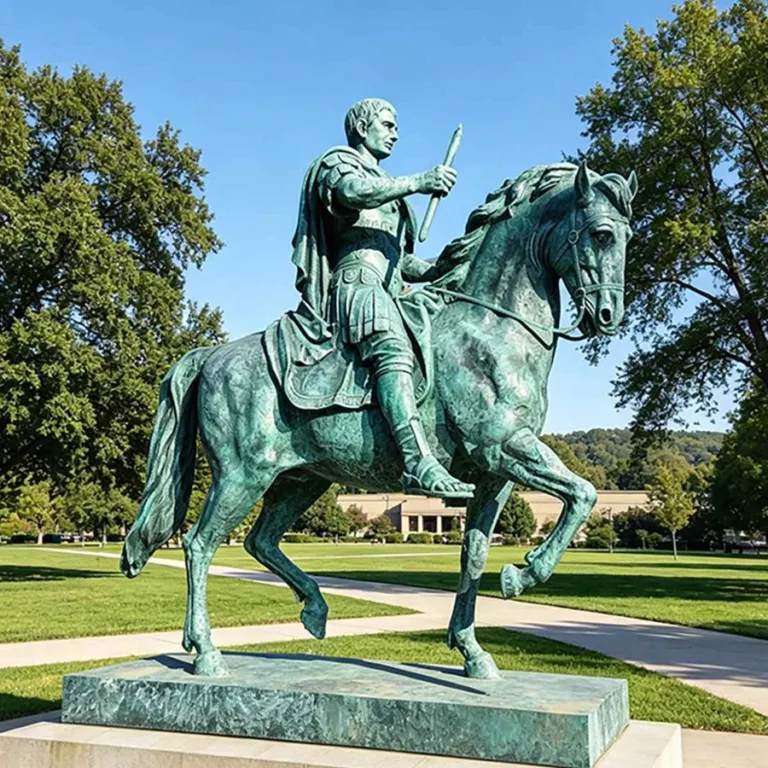
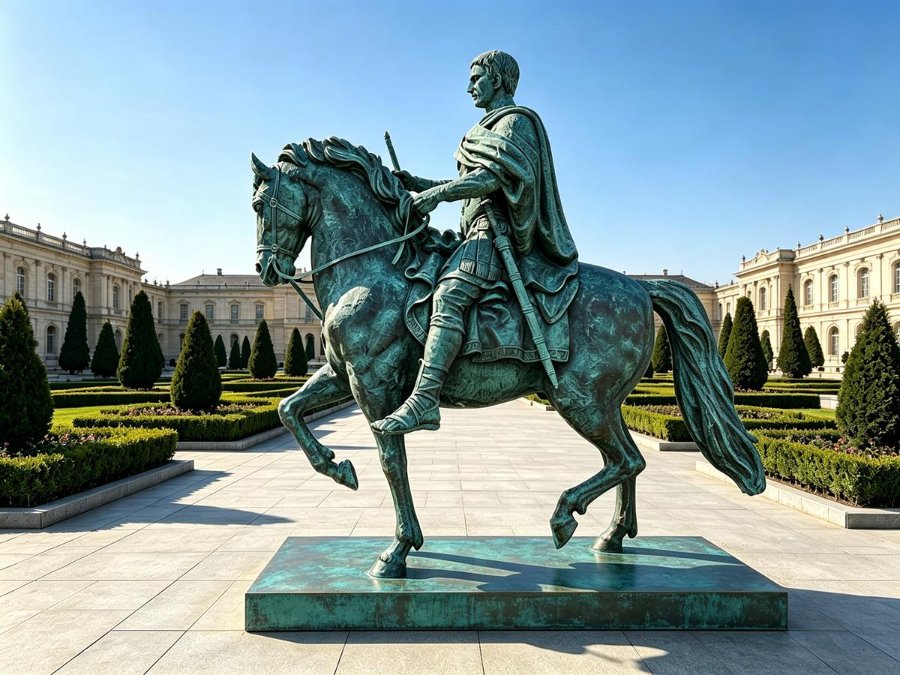
Horse and Rider: Memorial Weight and Equestrian Identity
A mounted figure reads as commemoration or club identity, and it earns the taller plinth it needs. Best at estate entrances, equestrian clubs, and memorial settings.
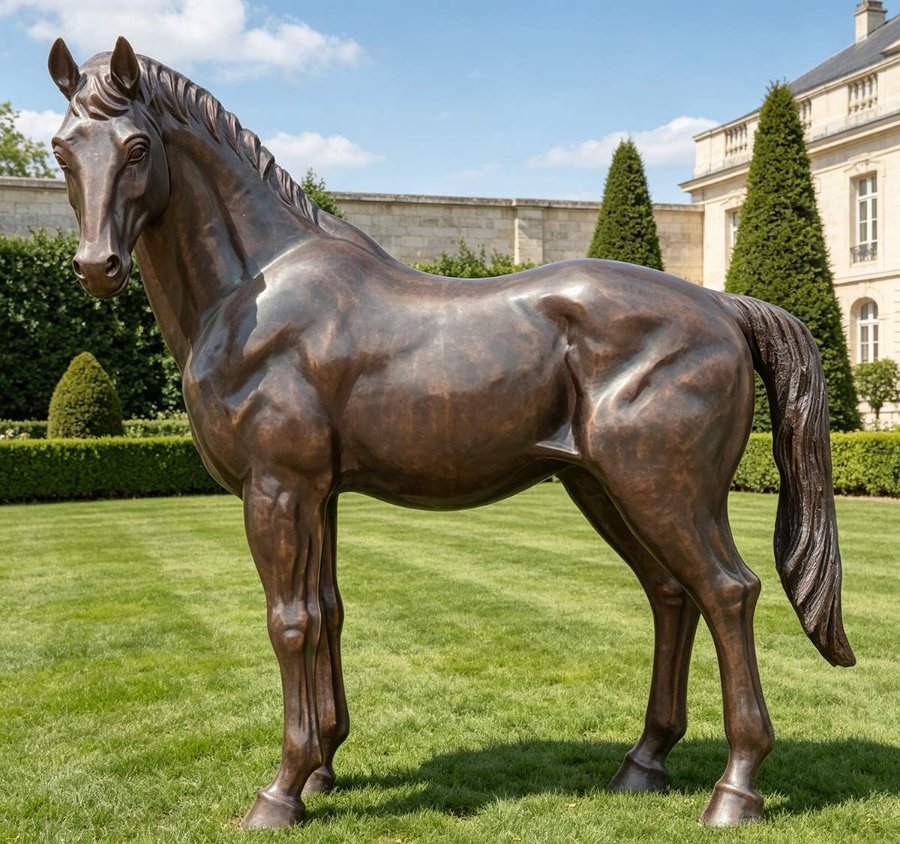
Standing: Formal Axes and Quiet Authority
The standing pose reads as stability and dignity — the natural choice for a formal axis, a symmetric facade, or a pair flanking an entrance. Decide the orientation deliberately: mirrored for symmetry, or both facing the approach.
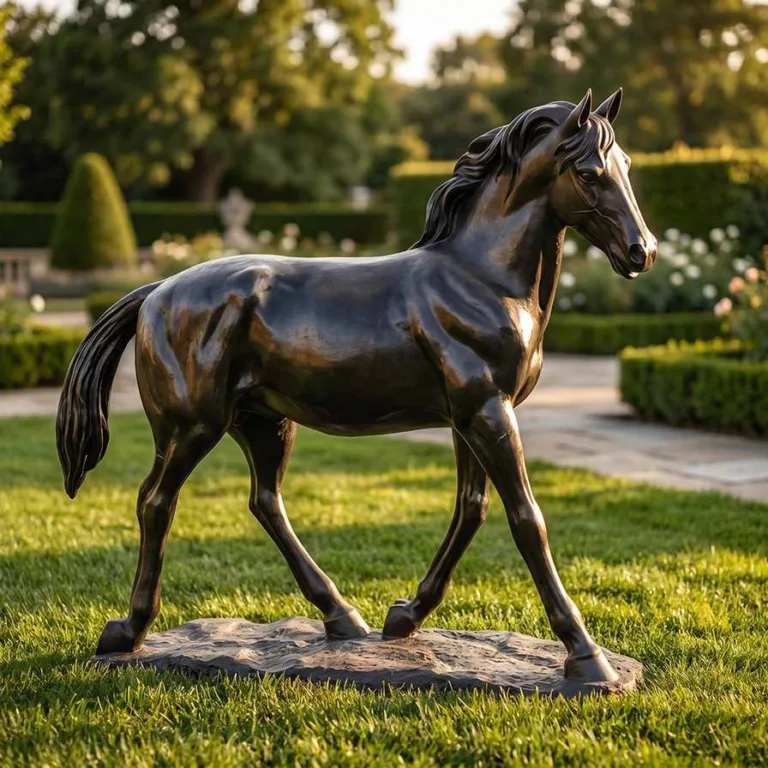
Walking: The Figure Mid-Journey
A walking horse implies movement without drama, which makes it the natural choice along a path, a drive, or a long border. It reads as purpose rather than display.
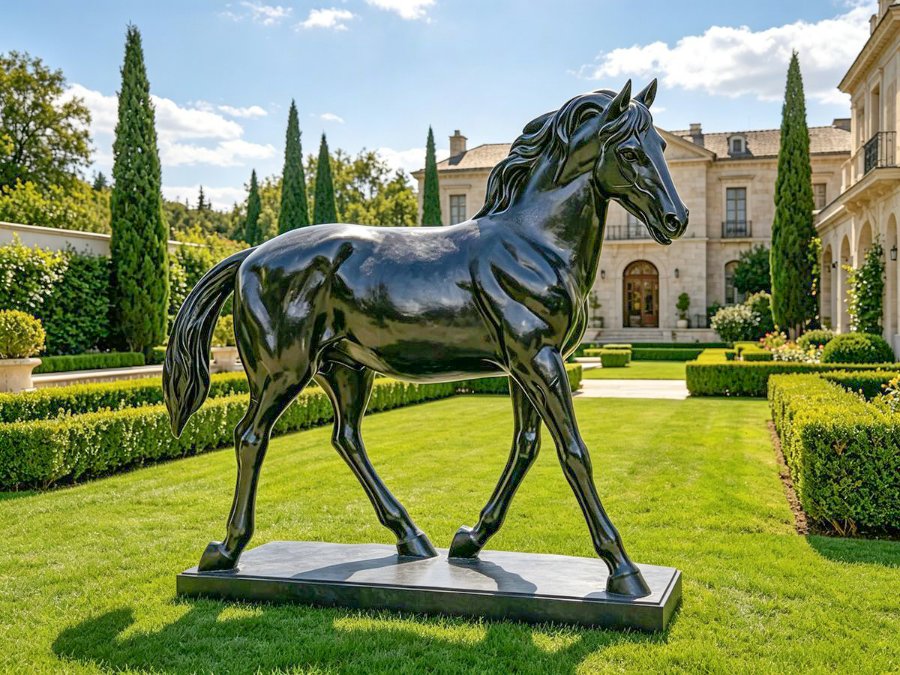
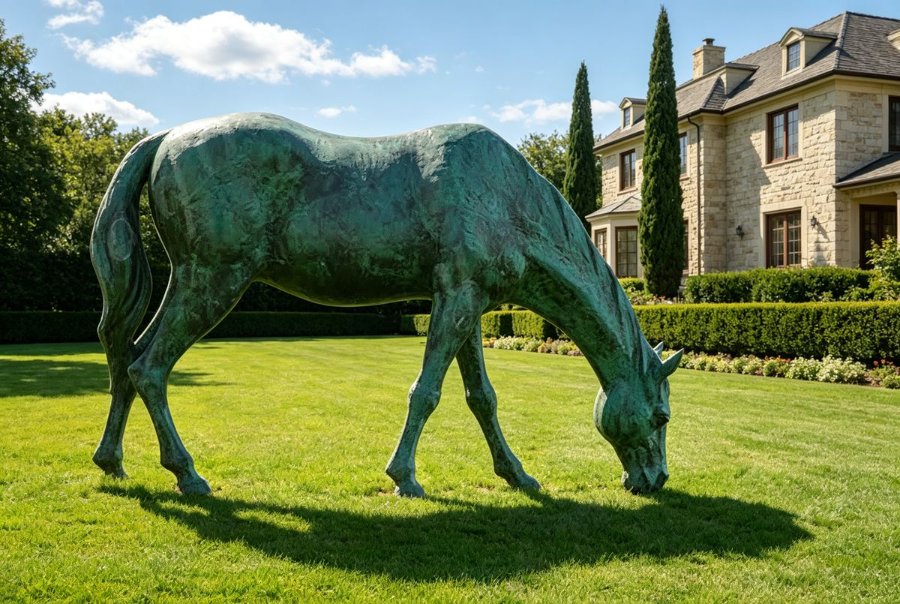
Grazing and Drinking: Naturalism That Disappears Into the Border
A lowered head is the most integrated pose, which is also its risk. Among mature planting at life size, a grazing horse can vanish; compensate with scale and a patina that contrasts against the greenery.
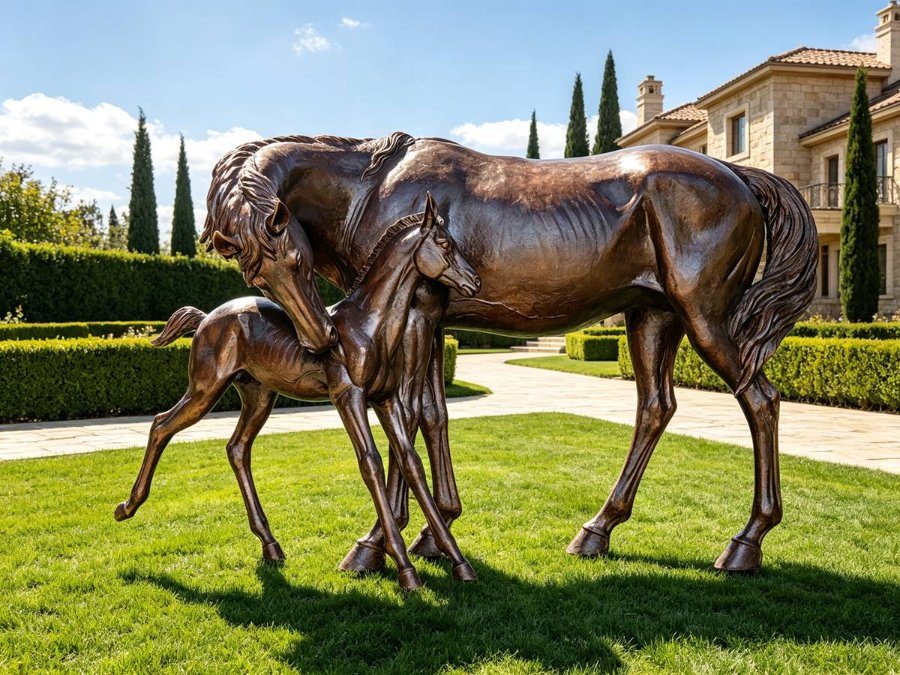
Mare and Foal: Warmth at Family Scale
A mare and foal group reads as a pair, so it needs width rather than height. Place it on a lawn seen from the house or a seating area, not at the end of a long view.
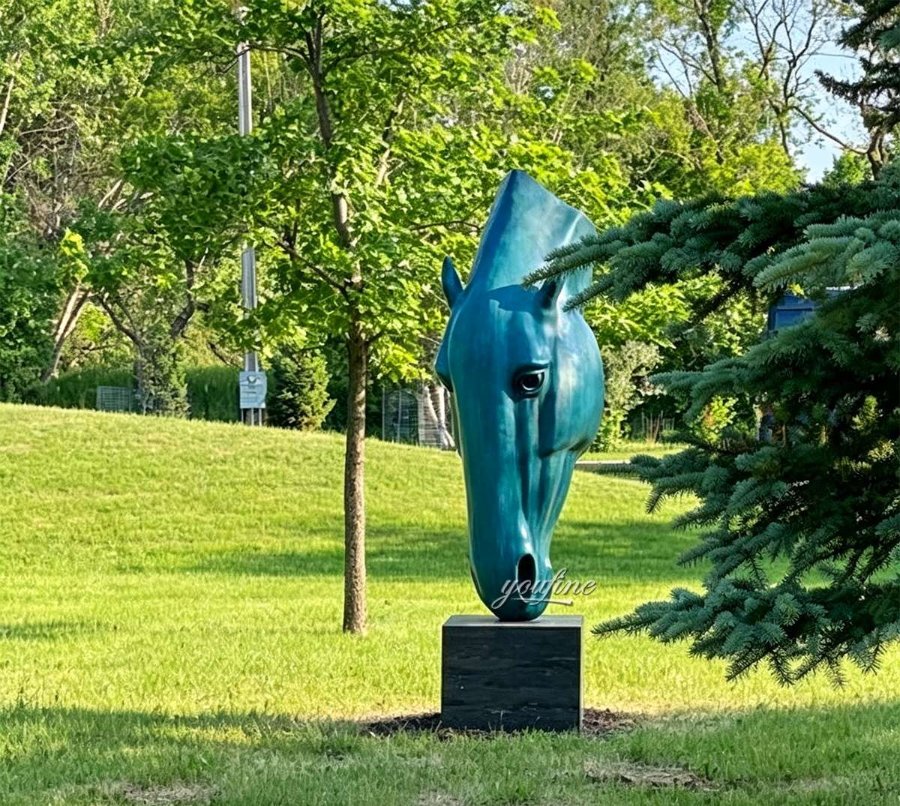
Horse Head: Monumental Presence in a Tight Space
Scaled up, a horse’s head and neck carry presence where a full figure will not fit — a terrace, a courtyard, a narrow bed. At monumental size it reads as a fragment by design, not a scaled-down portrait.
Choosing by Placement
| Pose | What it needs | Common mistake |
|---|---|---|
| Rearing | Open foreground, no backdrop | Set against a wall or hedge |
| Horse and rider | A taller plinth and an open approach | Mounted figure with no reason to be there |
| Standing | Left-right balance, clear approach | Pair with no deliberate orientation |
| Prancing / dressage | A formal surround, viewed up close | Scaled down until the detail is lost |
| Walking | A path, drive, or long border | Used as a static centerpiece |
| Grazing / drinking | A clear backdrop, not dense planting | Life size lost inside mature shrubs |
| Mare and foal | Width for two figures, seen from seating | Placed at the end of a long view |
| Horse head | A terrace, courtyard, or narrow bed | Treated as a scaled-down portrait |
When Scale and Pose Collide
The Same Pose at Two Scales Is Two Different Sculptures
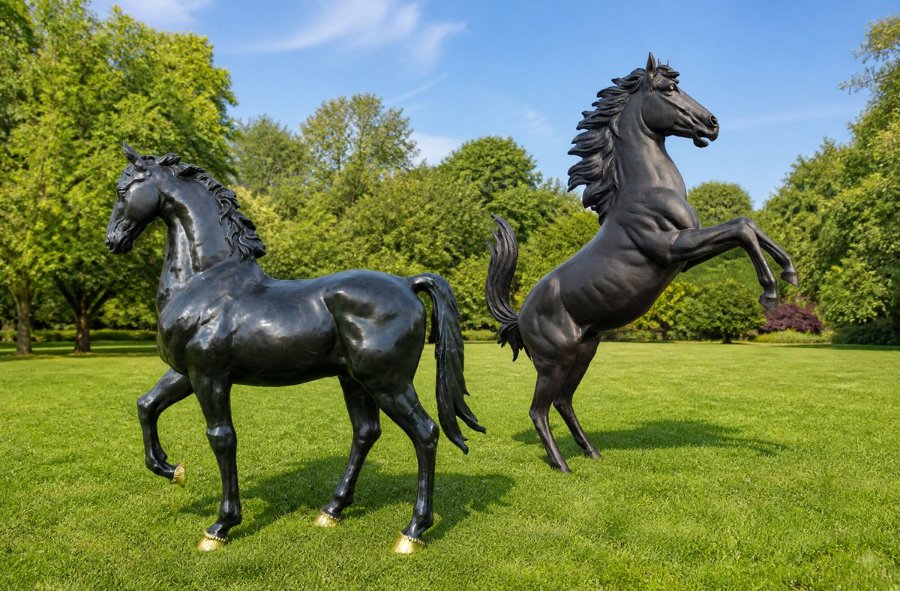
A rearing horse at life size reads as light, almost playful. At 1.25 times life size or more, the same pose becomes monumental, and the space it demands grows faster than its height. Pose sets the emotion; scale sets its intensity.
Why a Monumental Rearing Horse Needs an Internal Steel Armature
A rearing horse is structurally a cantilever: the weight of the body and forelegs rides on the hind legs, with the center of gravity well forward of the footprint. At life size, bronze thickness usually handles that load; at monumental scale it cannot, and the load must travel through an internal steel armature hidden inside the legs and tied into the plinth.
An internal steel armature is standard on every piece we cast. When we cast a three-meter rearing horse, our sculptors reinforce the rear hooves with internal steel armature so the piece stays stable outdoors for decades. Two details separate a sculpture that lasts from one that leans: wall thickness at unsupported sections, and how the armature connects to the base.
The Pose × Scale Matrix
Most combinations are safe, some deserve a site review, a few are best avoided. A monumental rearing horse in a small enclosed garden is not a scale problem but a setting problem, and no plinth will solve it.
A nine-horse public installation in the United States depended entirely on spacing and rhythm. A luxury garden pair at 3.05 meters depended on paired scale and mirrored orientation.
How to Judge a Foundry Before You Order
What the Casting and Finishing Process Should Show You
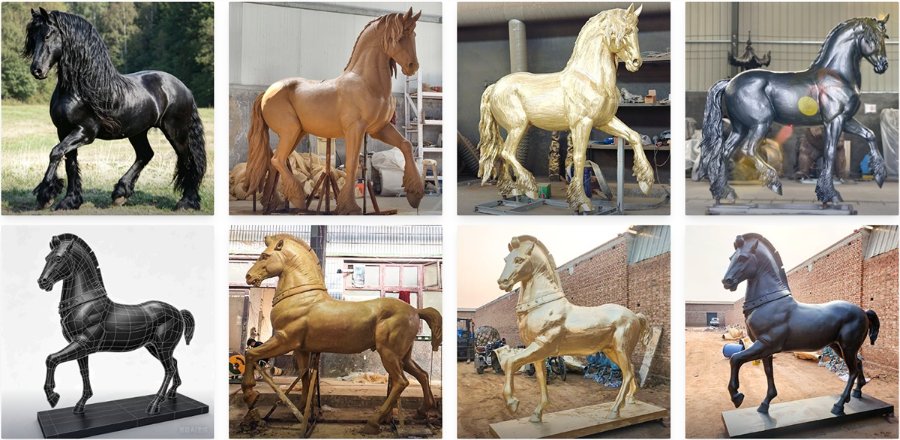
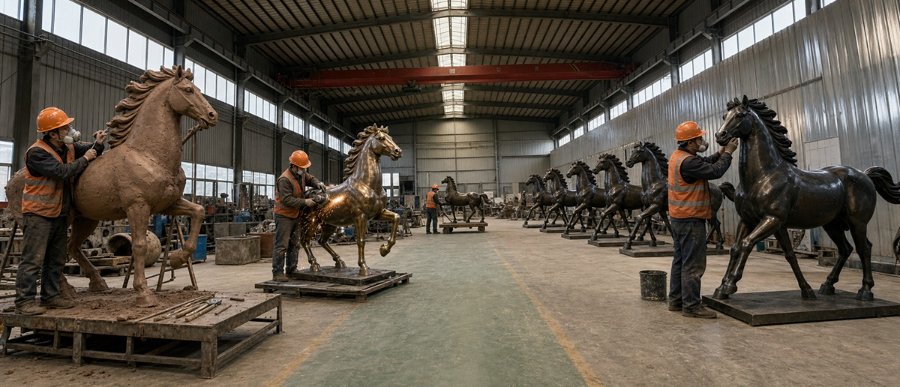
A foundry worth commissioning documents each stage — clay modeling, mold making, casting, welding, polishing, patina — and shows photographs of your own horse at every step, not a stock gallery.
Wall thickness and thin sections matter most where a horse is most recognizable: mane, tail, muscle transitions. Those same sections are where an outdoor bronze horse sculpture is most vulnerable.
Seven Questions to Ask Any Foundry
- Can you show photographs of my piece at each production stage?
- What wall thickness do you pour at, and how does it change with scale?
- Is an internal steel armature standard, and how is it connected to the base?
- Who applies the patina, and is it sealed after coloring?
- Do you model at full scale, or enlarge a smaller model?
- Can you share projects at a similar scale, and export records for my country?
- What does the quote include — crate, freight, foundation drawings, installation guidance?
What Drives the Price (and What Doesn’t)
Five variables explain almost every bronze horse statue quote: size and weight, pose complexity, patina complexity, base and foundation, and crating with ocean freight.
Pose complexity is the one buyers underestimate, because an unsupported pose costs more in structure than in bronze. The base is often quoted separately, which is why two identical-looking quotes can differ by a third.
A price that undercuts the rest by a wide margin usually means thin walls, no internal armature, or an unsealed patina.
Patina, the Base, and the Long-Term Reality
Matching Patina to Your Hardscape
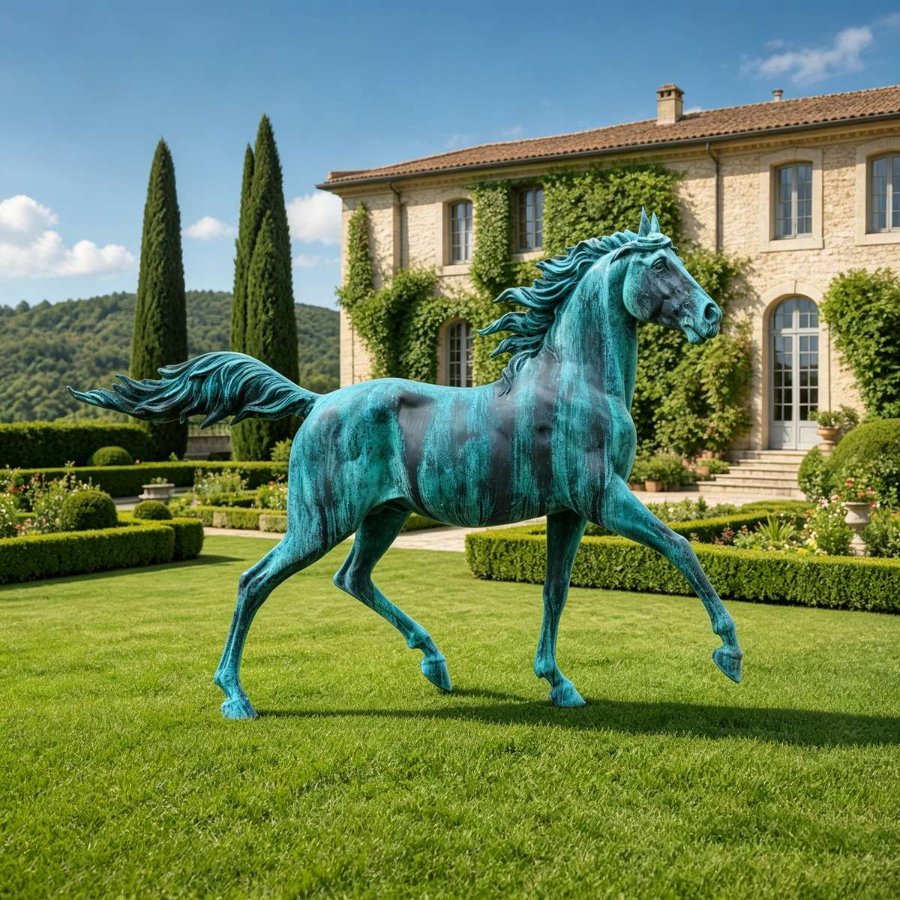
Read the surfaces around the installation point before choosing a finish. Dark brown and black-brown patinas hold strong contrast against pale stone and light facades, while a green verdigris sits more naturally against dark stone and deep planting, where a dark patina would disappear.
The Base Is Part of the Sculpture
Stone, concrete, and bronze bases trade visual weight against durability. Whichever you choose, plan the anchor and leave access for maintenance.
A Realistic Maintenance Rhythm
Bronze is durable, not maintenance-free. Fresh water rinses, a soft cloth, and periodic waxing protect the patina, and avoiding sprinkler overspray prevents the most common staining. Anyone promising an outdoor bronze horse sculpture that needs nothing is overselling.
Why Bronze Horse Foundry
Bronze Horse Sculpture Foundry has been a bronze horse manufacturer in China for more than forty years, casting in Quyang.
- 100% silica sol investment casting, for a higher surface finish and sharper thin-wall detail.
- An internal steel armature as standard on every piece.
- More than 500 bronze horse models — rearing, standing, racing, walking, grazing — plus fully custom work from clay modeling.
- Sizes from life size to monumental.
- Full-chain capability under one roof: clay modeling, mold making, casting, welding, polishing, patina, export-grade crating, worldwide freight coordination.
- Delivered to more than 30 countries, including the USA, UK, Germany, Australia, Canada, and the UAE.
If you are planning a custom bronze horse statue, the modeling stage is where your decisions are still inexpensive to change. Lead times depend on scale, pose, finishing, and then on sea freight and customs; we would rather give you the sequence of stages than a number that has to be revised twice.
Bronze Horse Statue FAQ: Five Questions Buyers Actually Ask
How long will an outdoor bronze horse statue last?
Decades, often longer — historic bronzes have survived centuries. Coastal air and sprinkler overspray accelerate wear.
How much does a life-size bronze horse statue weigh?
Typically 300 to 800 kg, depending on size, wall thickness, and casting method.
Can a bronze horse statue be customized in size and pose?
Yes — size, pose, patina, and base, and the modeling can follow photographs of a specific horse.
How is a large bronze horse statue installed?
Delivered in sections or as one piece, then secured to a concrete foundation with stainless steel anchor rods.
How is it shipped internationally?
In export-grade wooden crates with internal protection, by sea or air.
Conclusion
Three decisions carry almost all the risk. Measure the sightline before you fall in love with a model. Choose the pose for the mood the garden already has. Count the plinth as part of the sculpture.
Get those right and a bronze horse statue stops being an object in a garden and becomes part of the garden. Get them wrong and it will only grow more conspicuous.
If you have a garden plan and the main sightline distance, send them to us at https://bronze-horse.com/. We will suggest two or three scale and pose options, with pricing direction, before you commit.